
5 Questions to Ask Every AI Speaker Before You Sign the Contract
Jun 01, 2026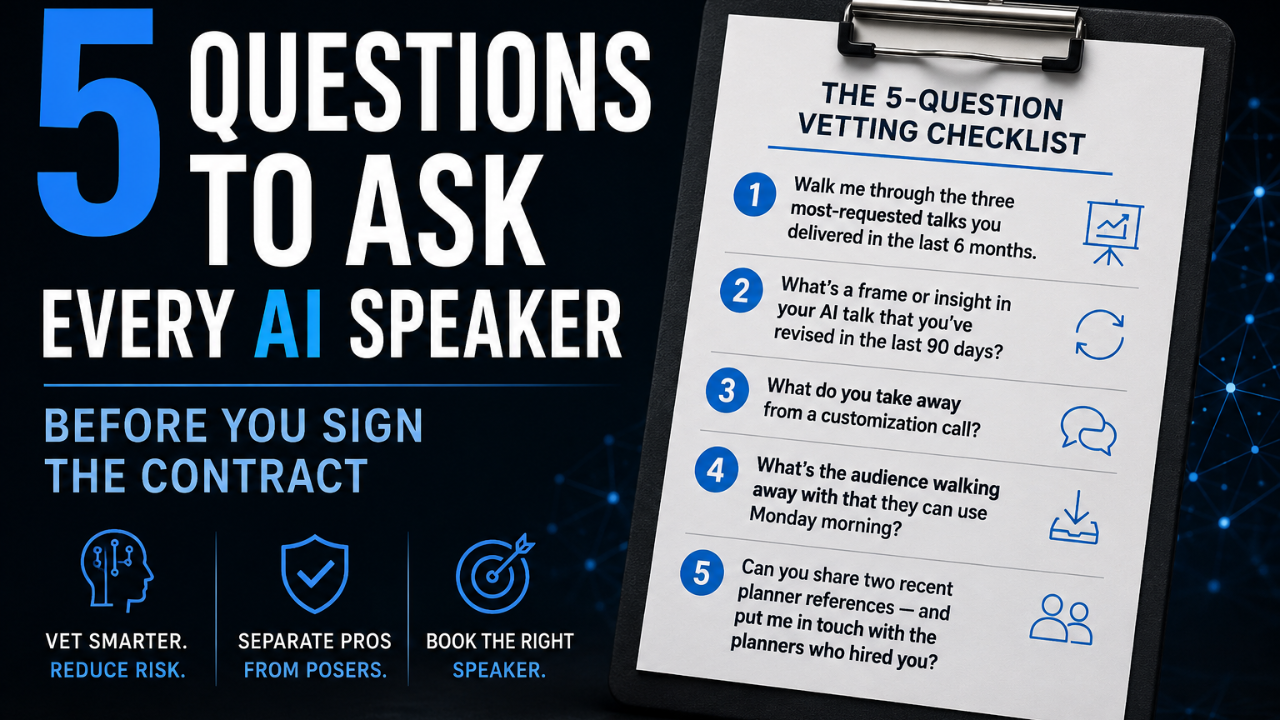
If you're vetting AI productivity keynote speakers for a 2026 event, you have a vetting problem.
Not a speaker shortage problem. The opposite. Your inbox is full of pitches. Every consultant on LinkedIn has rebranded as an "AI productivity expert." The bar to claim that label has fallen through the floor, while the actual cost of hiring the wrong speaker has gone up. A weak AI keynote in front of 800 senior leaders doesn't just waste the slot. It damages your event's credibility and your own.
After 20 years on the speaking side and a fair amount of time on the planning side, I've watched the same pattern play out at scale. The speakers who actually deliver get spotted in five questions or less. The ones who don't, get spotted in six.
Here are the five. Ask all of them. Listen carefully to the texture of the answers, not just the words. Each one is designed to filter for something specific.
1. "Walk me through the three most-requested talks you delivered in the last six months."
What this filters for: actual track record.
Real practitioners have a clear answer with specific titles, audience types, and what changed in each version. They've done this enough that they know which talks land, with whom, and why. They can rattle off three without thinking.
Impostors give a generic answer like "I custom-build everything from scratch for each event" or "I tailor my content to whoever's in the room." That's code for "I don't have a tested deck and I'm hoping you don't ask follow-ups."
Bonus probe: ask them to forward you ONE recent run-of-show deck (not the slides, just the agenda). A speaker with three battle-tested talks will have this on hand within an hour. A speaker without one will need a week to make it up.
2. "What's a frame or insight in your AI talk that you've revised in the last 90 days?"
What this filters for: currency.
AI is moving so fast that any speaker whose deck hasn't changed in a quarter is using stale demos and stale examples. ChatGPT shipped major upgrades twice in the last six months. Claude has new capabilities monthly. Copilot has shifted from a search assistant to a workflow agent. A speaker who can't name a specific revision they've made recently is reading off slides from 2024.
The right answer is specific. Something like "I retired my GPT-3.5 demo and replaced the Copilot section because Microsoft shipped the agentic update." Or "I cut my Notion AI example because Notion's API changed how it integrates."
Bonus probe: ask what they think will need to be revised in their deck six months from now. Real practitioners are watching upstream. They can point to specific bets they're tracking.
3. "What do you take away from a customization call?"
What this filters for: how they think about preparation.
Listen for verbs. "I learn," "I ask about," "I dig into," "I research," "I want to understand." Those are the verbs of speakers who treat the discovery call as inquiry.
Watch out for: "I find out what kind of vibe you're going for," "I get a sense of the room," or worst, "I confirm the basics so I can apply my framework." Those are the verbs of speakers who treat the call as logistics. They're going to give your audience whatever talk they were already going to give.
The best version of this answer reads like a research methodology. "I want to understand who's in the room by role and tenure, what they've heard from previous speakers, what their biggest 2026 challenge looks like in their words, and what success looks like at the end of my session." That's a person preparing to do real work.
4. "What's the audience walking away with that they can use Monday morning?"
What this filters for: substance vs. entertainment.
If the answer is "inspiration," "a new way of thinking," "a fresh perspective," or "energy and motivation" - they're a motivational speaker, not an AI productivity expert. Nothing wrong with motivational speakers, but you'd be hiring the wrong shape of person for this slot.
If the answer includes specific deliverables - checklists, prompt templates, decision frameworks, AI workflow examples, copy-paste snippets, downloadable resources, follow-up emails with referenced tools - you're talking to someone who actually does the work. Audiences in 2026 don't want to be inspired about AI. They want tools they can use Tuesday.
Bonus probe: ask if their session includes any take-home materials, and what form they take. A real practitioner will offer a recap email, a workbook, a prompt library, or a Notion template. A motivational speaker will offer a quote graphic.
5. "Can you share two recent planner references - and put me in touch with the planners who hired you, not the executive sponsor?"
What this filters for: actual operating quality.
This is the cleanest single filter in the whole list. Speakers who are pros at the operational side will offer planner references without flinching. The references will pick up your call within a day. The reference will use phrases like "easy to work with," "flexible on stage," "sent materials early," "didn't need hand-holding from our AV team."
Speakers who are not great operationally will:
- Push back on the request ("I only have sponsor references handy")
- Send you references who never quite return your calls
- Or send you references who praise the keynote content but go silent when you ask about logistics, prep, day-of behavior, or follow-through
Sponsors will always say nice things. They saw the keynote, they got the reaction, they're happy. Planners know the full story - including whether you sent your bio in by the deadline, showed up on time, asked smart questions about the AV setup, and emailed them Monday with a thank-you.
If the planner reference is enthusiastic AND specific about what made you easy to work with, you've found a pro.
How to use these five questions
Send them in writing 24 hours before your discovery call. Tell the speaker you'd like to walk through them together on the call. This does three things at once:
- Real practitioners will appreciate it. They'll show up with thoughtful answers. The conversation will be deeper than usual.
- Impostors will start hedging immediately, either by canceling the call, rescheduling, or showing up unprepared. Either way, you have your answer.
- You won't have to remember them in the moment, which means you can listen to the texture of the answers instead of staring at your notes.
Plan on 30 minutes for the call. If a speaker can't answer five questions in 30 minutes, that's a 6th data point - and not the one you want.
The full vetting framework
These five questions are pulled from a longer planner's guide I published earlier this month - one that covers the credentials that actually matter, the brief you should send before signing, the red flags I've seen burn other planners, and the operational expectations a real practitioner will meet without being asked.
If you're seriously vetting AI keynote speakers for an event in the next 90 days, read the longer guide here: roadmaptofreedom.com/blog/how-to-hire-keynote-speaker-ai-productivity
Or - if you'd rather just see if I'm the right fit for your event - my Speaker Kit is free to download. It includes my 2026 talk titles, customization examples, recent planner references, and the AV requirements doc. You can decide in about 15 minutes.
|
Want my full vetting checklist as a PDF? I've turned these 5 questions plus 12 more (covering credentials, briefs, red flags, and post-event expectations) into a one-page planner's checklist you can save to your bookmarks bar. Download it free at roadmaptofreedom.com/speaking - it's part of the Speaker Kit. |
Chris McIntyre is a Certified Speaking Professional with 20+ years and 2,000+ keynotes across all 50 U.S. states and four continents. He has spoken for Google, NASA, Comcast, Lucasfilm, the United Nations, NCAA, and YPO. MIT AI Strategy certified.