
Proving It: The 3 Metrics Every AI Pilot Must Show Your Board
Sep 14, 2026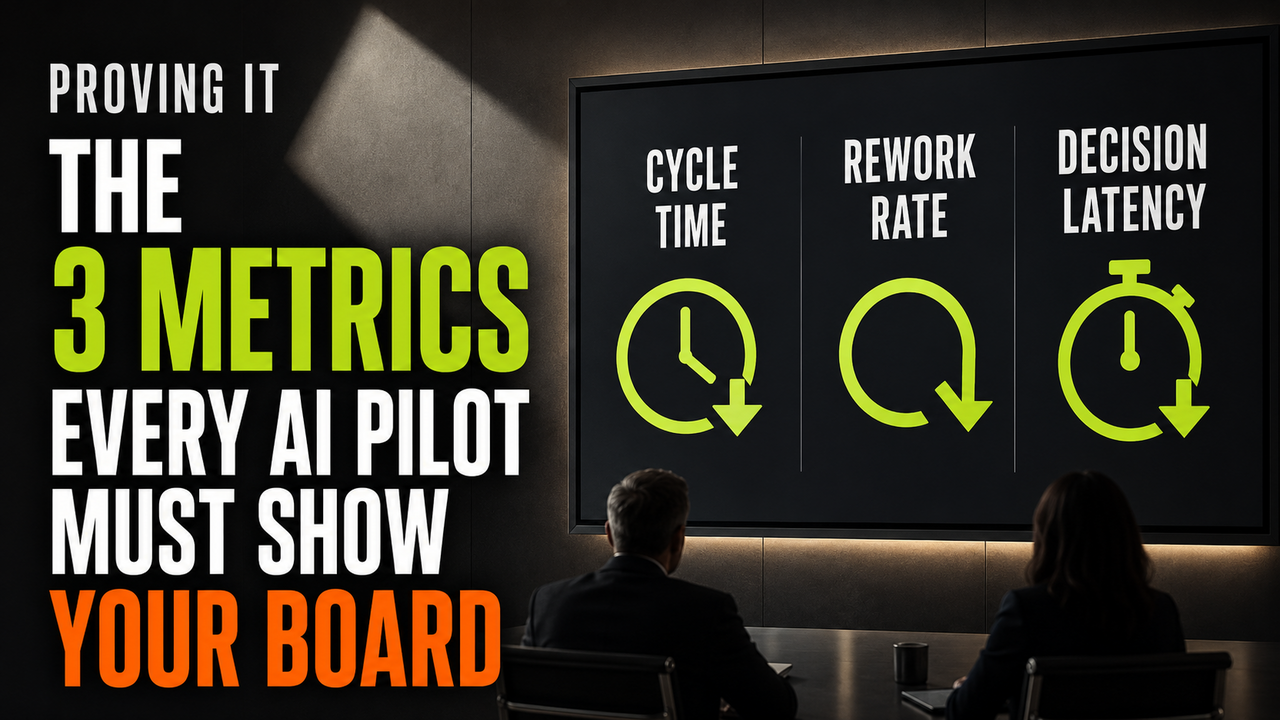
Most AI pilots die quietly, and they almost always die the same way. Not because the technology failed. Because when it came time to show results, the team walked into the room with the wrong numbers.
They showed activity. Seats deployed, prompts run, hours "saved" by a self-reported survey, a slide of enthusiastic quotes. And the board, or the CFO, or whoever controls the next budget, looked at it and thought: that's motion, not outcome. Where's the actual return? The pilot gets a polite nod and no expansion, and everyone concludes AI "didn't deliver," when the truth is the pilot never measured anything that would have proven it did.
If you're running an AI pilot and you want it to survive contact with your board, you need three numbers. Not activity metrics. Outcome metrics. Here they are, along with the guardrail that keeps them honest.
Why activity metrics kill pilots
Activity metrics feel safe because they're easy to collect and always go up. Usage climbs, logins climb, "time saved" climbs because you asked people and people are optimistic. The problem is that none of them answer the only question a board is actually asking: did this change a business outcome we care about?
"We ran 40,000 prompts last quarter" is not a result. It's a receipt. Worse, it invites the exact skepticism you're trying to overcome, because a sharp CFO knows that activity and value are not the same thing, and leading with activity signals you couldn't find the value. The fix is to measure the pilot the way the business measures everything else: by outcomes.
Metric 1: Cycle time
Pick a specific, important process the pilot touches, and measure how long it takes from start to finish, before and after. Contract turnaround. Deal-close time. Report production. Time-to-first-response. Onboarding duration.
Cycle time is the cleanest proof of value because it's objective, it's already meaningful to the business, and it maps directly to money and capacity. "Client onboarding went from eleven days to four" is a sentence a board understands instantly, because they already know what a faster onboarding is worth. It requires no translation and no faith. You measured a real process and it got measurably shorter.
The discipline: choose the process before the pilot starts and measure the baseline first. The single most common pilot mistake is trying to reconstruct "how long did this used to take" after the fact, which produces a number no one trusts. Baseline first, or the whole comparison is guesswork.
Metric 2: Rework rate
Speed alone is a trap, and a good board knows it. Anyone can go faster by cutting corners. So the second metric guards the first: how often does the work have to be redone?
Rework rate is the percentage of outputs that come back, errors caught downstream, drafts rejected, deliverables that needed a do-over. You measure it before and after the pilot, right alongside cycle time. Together they tell the real story. If cycle time drops and rework holds steady or falls, you've got a genuine win: faster and at least as good. If cycle time drops but rework spikes, you didn't compress the work, you just moved the cost downstream and hid it. That's the metric that keeps you honest, and showing it unprompted builds enormous credibility, because it proves you were looking for the catch.
Metric 3: Decision latency
The third metric is the one most pilots miss, and it's often where the biggest executive value actually lives. Decision latency is how long it takes to get from "we need to decide this" to "it's decided," in writing, with an owner.
So much organizational time is lost not in doing work but in waiting to decide, gathering the analysis, aligning the stakeholders, scheduling the meeting, relitigating it twice. If your pilot compresses that, by giving decision-makers better-prepared options faster, it's creating real leverage, but it's invisible unless you measure it. Track how long your key decisions take before and after. When decision latency drops, the whole organization speeds up, because decisions are the thing everything else waits on.
The one-sentence version for the board
Here's how the three fit together into something a board can't wave away: "This process got faster (cycle time), without getting sloppier (rework rate), and we're making the decisions around it quicker (decision latency)."
That sentence is fundamentally different from "usage is up and people love it." It's in the language of business outcomes, it pre-empts the obvious objection about quality, and it connects to things the board already values. It's the difference between a pilot that gets expanded and one that gets thanked.
Set this up before you start
The reason most pilots can't produce these numbers is that they weren't instrumented for them. You cannot retrofit a baseline. So before the pilot begins: pick the one or two processes it will touch, measure current cycle time and current rework rate, and identify the key decisions whose latency you'll track. Small, specific, and measured from day zero beats broad and unmeasurable every time.
And resist the pull toward vanity breadth. A pilot that proves a real outcome on one process is worth ten pilots that show impressive activity across twenty. The board is funding the next phase based on whether you can prove value here, once, cleanly.
So the question to answer before your pilot's review date, not after: when you walk into that room, will you be showing how much the tool was used, or how much a business outcome changed? If it's the former, you may already be measuring your pilot to death. There's still time to fix it, but only if you baseline before you build.
The pilot-metrics framework, including the baseline worksheet, is part of the AI Productivity Roadmap. It's free to download.
Chris McIntyre is a Certified Speaking Professional and MIT AI Strategy certified. He has trained over 300,000 professionals worldwide on AI productivity, leadership, and accountability. Clients include Google, NASA, Comcast, and the United Nations.