
The Meeting That Should Have Been a Prompt: How to Cancel a Third of Your Calendar
Oct 12, 2026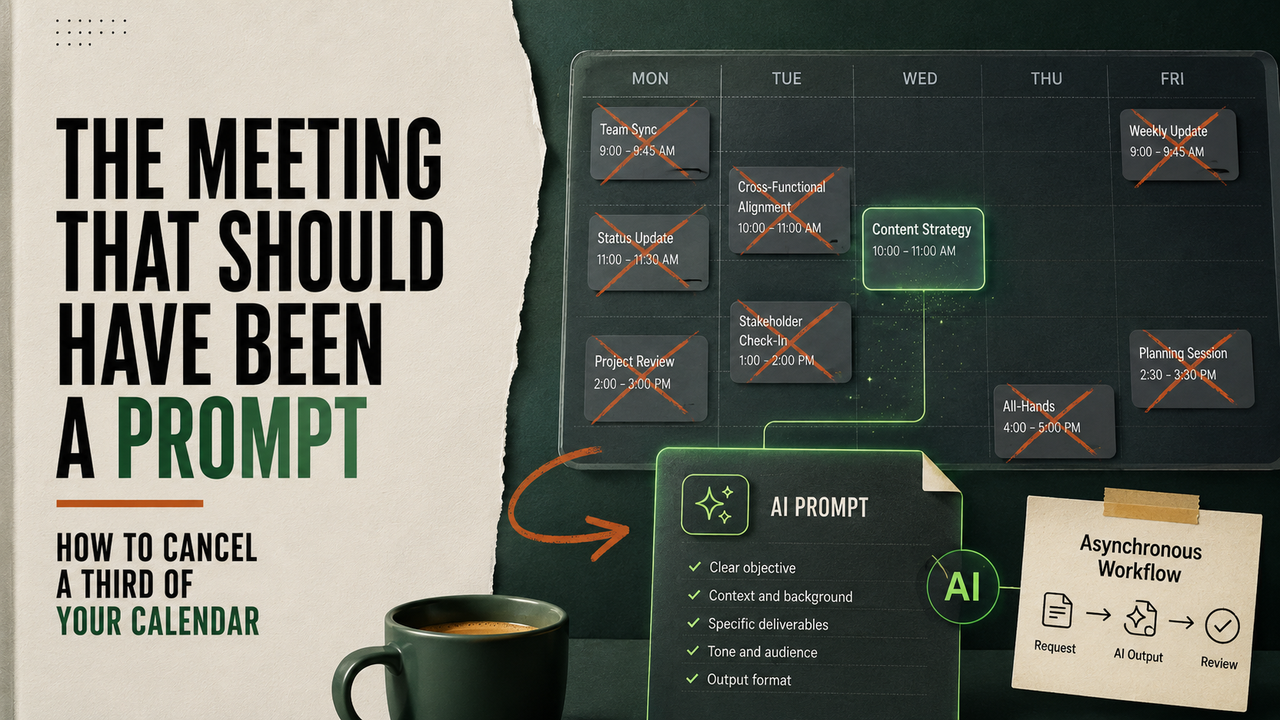
Look at your calendar for next week. Really look at it. Now ask a question most leaders never ask about any single meeting on there: what is this for? Not the topic. The output. What has to be true at the end that isn't true now, and does producing it actually require putting several expensive humans in a room at the same time?
For a large share of the meetings on your calendar, the honest answer is no. They exist out of habit, or because "we always sync on Thursdays," or because sending an update in a meeting feels more accountable than sending it in a document. And now, for the first time, AI makes it practical to cancel a real chunk of them, not by being ruthless, but by moving the work to a format that's faster and better anyway.
The test: does this need to be synchronous?
Every meeting is really an answer to a question, and the question is almost never "do we need to discuss this?" It's "do we need to discuss this at the same time, in real time?" Synchronous time is the single most expensive resource an organization has. A one-hour meeting with eight people isn't an hour. It's a workday, gone, plus the fragmentation cost of eight calendars carved up around it.
So the test for any recurring meeting is simple: strip out everything that could happen asynchronously, and see what's left. What's left, the genuine real-time need, is usually much smaller than the meeting. And the part you strip out isn't lost. It moves to a written format that more people can absorb, on their own time, at their own pace. AI is what makes that written format cheap enough to actually produce.
The three meetings hiding on your calendar
Most meetings that should be canceled fall into three types, and each has an AI-powered replacement that's genuinely better.
The status meeting. Everyone goes around and reports what they did. This is the purest waste on any calendar, because status is information transfer, and information transfer does not need to be synchronous. Replace it: each person's update gets drafted by AI from their actual work (their tickets, their notes, their commits), compiled into a single digest, and read in five minutes by whoever needs it. The meeting that ate an hour a week becomes a document that takes minutes to produce and minutes to consume.
The update-to-the-boss meeting. A recurring slot that exists mostly so you feel informed. Replace it with an AI-generated briefing: the key movements, the risks, the decisions pending, pulled together and summarized, waiting for you when you want it. You stay more informed, not less, and you free the hour, and your report stops spending their morning preparing to perform for you.
The "let's get aligned" meeting with no decision. Called to build shared understanding, which is real, but shared understanding is usually better built by a well-written document people can sit with than by a discussion half the room half-remembers. Have AI turn the context into a clear brief, circulate it, and hold a meeting only if genuine disagreement surfaces. Often none does, and you've saved the room.
What the leftover meetings are for
Canceling meetings isn't about hating meetings. It's about protecting the ones that genuinely need to be synchronous so they can be great. Some things truly require real-time humans: a hard decision where you need to read the room, a creative session where ideas build on each other live, a conversation with real emotional stakes, a negotiation. These are irreplaceable, and they get better when they're not crammed between six status meetings that drained everyone first.
The move is a portfolio shift. Cancel the meetings that were really documents in disguise, which AI can now produce cheaply, and reinvest that reclaimed time and attention into the few meetings that actually justify pulling people together. You end up with a lighter calendar and better meetings, at the same time.
How to actually do it
Don't announce a purge. Pick your single most questionable recurring meeting, the status one is usually the easiest, and run the experiment for a month. Replace it with an AI-compiled written update. Tell the group you're testing whether the document can do the meeting's job. Watch what happens. Almost always, nobody misses the meeting, everyone appreciates the hour, and the written version turns out to be more useful because it's searchable, skimmable, and doesn't require being present at a fixed time.
Then do the next one. This spreads on its own, because the people freed from a useless meeting become advocates for freeing the next one. You're not fighting a culture war against meetings. You're demonstrating that a document can do a specific job better, one meeting at a time.
There's a leadership signal in this too. When you cancel a meeting and replace it with something better, you're telling your organization that you value their time and their focus, that you'd rather they do the work than perform the update. That message compounds. In a world where everyone's calendar is under assault, the leader who actively protects their team's attention becomes the one people most want to work for.
So here's the question for your calendar this week: pick the meeting you'd least miss, and ask honestly whether its real output could be a document AI helps produce, read on everyone's own time. If it could, you've just found an hour a week for every person in that room. Multiply that across a year. That's not a scheduling tweak. That's real capacity, hiding in plain sight on your calendar.
The full meeting-audit method, including the async-replacement templates, is in the AI Productivity Roadmap. It's free to download.
Chris McIntyre is a Certified Speaking Professional and MIT AI Strategy certified. He has trained over 300,000 professionals worldwide on AI productivity, leadership, and accountability. Clients include Google, NASA, Comcast, and the United Nations.