
Your Company's Knowledge Is Trapped in People's Heads. AI Can Finally Get It Out.
Oct 26, 2026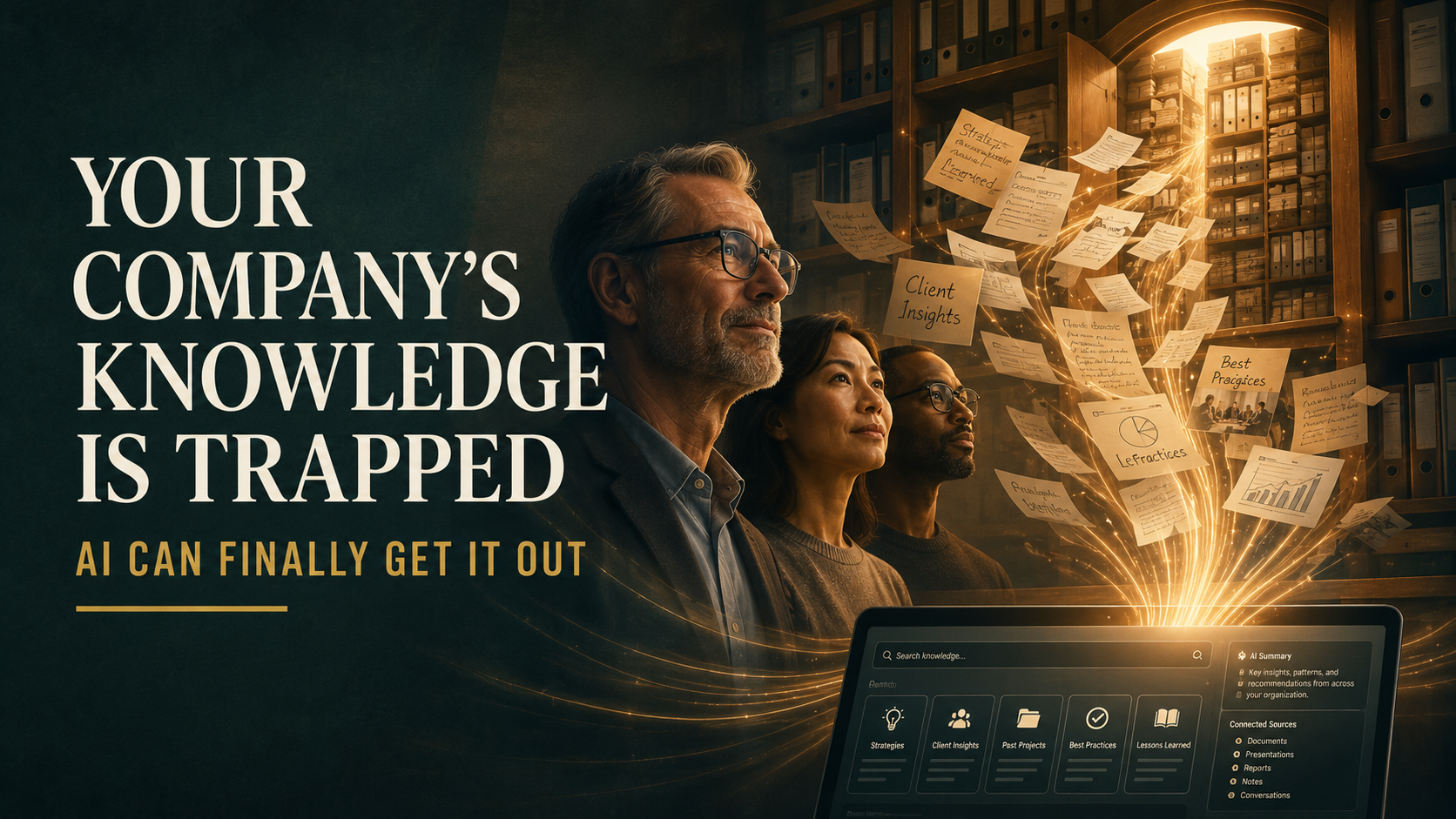
Every company has a hidden asset that never shows up on the balance sheet: the knowledge locked inside its people's heads. How your best salesperson actually handles the tough objection. The workaround your veteran engineer uses that isn't documented anywhere. The reason you stopped doing things a certain way three years ago, known only to the two people who were there. This knowledge is often the real difference between your organization and a competitor with the same tools and the same headcount. And most of it is one resignation away from walking out the door forever.
Leaders have always known this was a problem. The trouble was that the fix, getting knowledge out of heads and into a usable form, was so laborious that it almost never happened. Documentation was a chore everyone avoided, the resulting documents were stale the moment they were written, and nobody read them anyway. AI changes the economics of this completely. For the first time, capturing institutional knowledge is cheap enough to actually do, and useful enough that people actually use it.
Why knowledge stayed trapped
It's worth understanding why this problem persisted for so long, because it explains why AI is the thing that finally cracks it. Knowledge stayed in people's heads for three reasons, and AI addresses all three.
First, extraction was expensive. Getting an expert to write down what they know is slow and painful, because much of their expertise is tacit, they do it without consciously knowing the steps. Second, the output was unusable. Even when someone documented a process, the result was a dead document, hard to search, quick to go stale, and disconnected from the moment you actually needed it. Third, there was no incentive. Experts are busy and often, consciously or not, protective of the knowledge that makes them valuable. So the knowledge stayed put, and every departure was a quiet loss the company absorbed without ever quite measuring.
How AI gets it out
AI attacks the extraction problem directly, and in a way that finally respects how experts actually think. Instead of asking someone to sit down and document a process cold, which is exactly the task human experts are worst at, you let AI interview them, in the flow of their real work.
The expert handles a real situation the way they always do. AI observes, or is walked through it, and asks the clarifying questions a smart apprentice would ask: why did you do that and not the obvious thing, how did you know this was the important detail, what would have made you decide differently. Those questions surface the tacit reasoning the expert couldn't have written down on their own, because they weren't consciously aware of it. The output isn't a dead document. It's living knowledge that can be queried in the moment someone needs it, updated as the expert refines it, and drawn on by the whole team rather than the one person who happened to know.
The three kinds of knowledge worth capturing
Not all institutional knowledge is equally worth the effort. Three kinds pay off the most.
The expert's judgment. How your best people make the calls that separate them from the average. This is the highest-value and hardest-to-capture knowledge, and it's exactly what AI's interview approach is good at surfacing, because it's the tacit reasoning experts can't easily articulate but can demonstrate.
The institutional memory. Why things are the way they are. The decisions made and the reasons behind them, the things tried and abandoned, the context that new people lack and keep painfully rediscovering. This is what walks out the door when veterans leave, and it's what causes organizations to relearn the same lessons every few years.
The recurring how-to. The processes people do often but that live only in a few heads, so the whole team bottlenecks on those few people, and everything stops when they're on vacation. Capturing these breaks the bottleneck and makes the organization more resilient.
The onboarding dividend
The most immediate payoff shows up in how fast new people become effective. Traditionally, a new hire's real education came from months of absorbing tacit knowledge by osmosis, asking colleagues, making mistakes, slowly building the context that veterans carry. It's slow and expensive, and it pulls your best people away from their work to answer the same questions repeatedly.
When institutional knowledge is captured and queryable, a new person can ask the questions they'd otherwise have to interrupt a colleague for, and get the real answer, the one that includes the why and the context, not just the surface procedure. Onboarding compresses from months to weeks, your experts stop being a help desk for the same recurring questions, and new hires reach real productivity faster. That's a direct, measurable return.
The accountability line
One caution, because it matters. Captured knowledge is an input to human judgment, not a replacement for it. The goal is to give people access to the organization's accumulated wisdom, not to let them stop thinking. A new hire who queries the captured judgment of your best salesperson should be learning to make the call themselves, faster, not blindly executing a script they don't understand. Knowledge capture accelerates the development of judgment. It doesn't substitute for it, and a leader should be clear about that distinction when rolling it out, or you'll build a team that can look things up but can't think.
The strategic point is bigger than efficiency. In a world where every company has access to the same AI tools, your durable advantage is your specific, hard-won, accumulated organizational knowledge, the stuff that took years to learn and that no competitor can download. The leaders who systematically capture that knowledge are compounding an asset that's genuinely defensible. The ones who leave it locked in individual heads are one resignation away from losing pieces of it permanently, and they'll never know exactly what they lost.
So the question worth asking about your own organization: if your three most knowledgeable people left next month, what would walk out the door with them, and how much of it exists anywhere but in their heads? Whatever your honest answer, AI has just made it far cheaper to get that knowledge out before you're forced to learn its value the hard way.
The full knowledge-capture playbook, including the AI-interview method, is in the AI Productivity Roadmap. It's free to download.
Chris McIntyre is a Certified Speaking Professional and MIT AI Strategy certified. He has trained over 300,000 professionals worldwide on AI productivity, leadership, and accountability. Clients include Google, NASA, Comcast, and the United Nations.