
Decision Cadence: The Priority Stack That Keeps AI From Just Making You Busier
Aug 10, 2026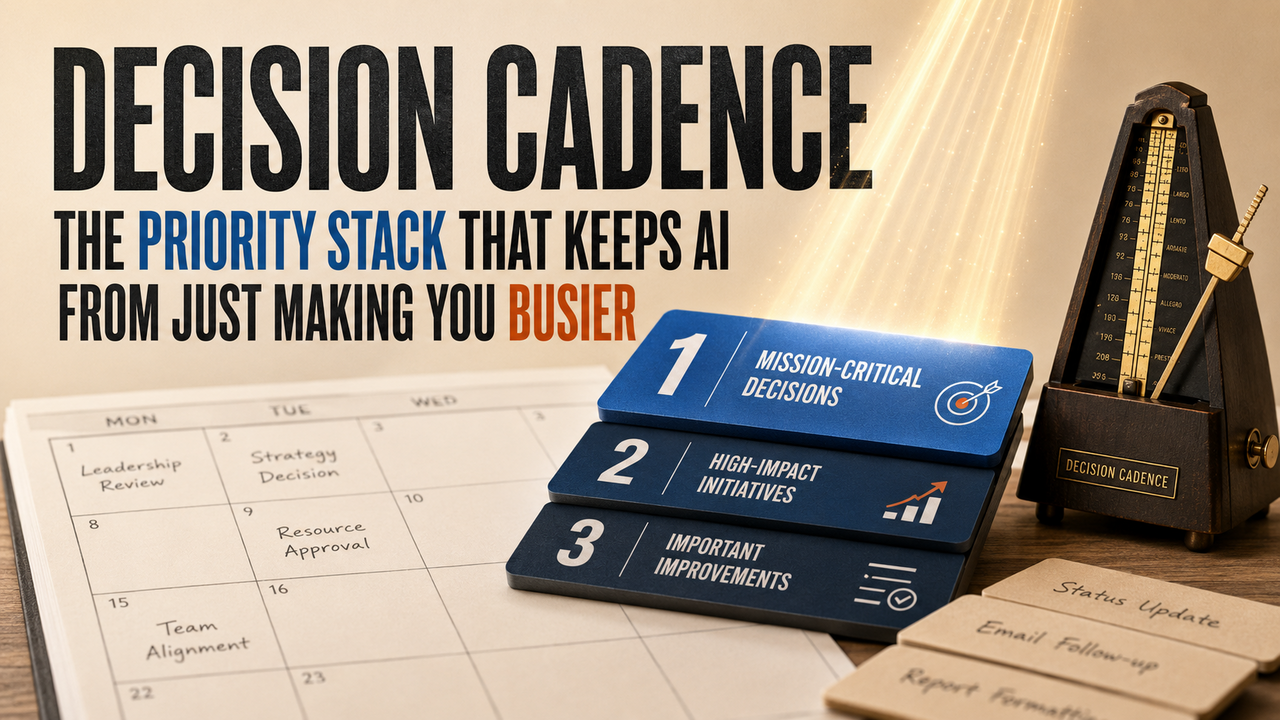
Here's a pattern I've started warning executives about, because almost no one sees it coming. You bring in AI to save time. Six months later, you're busier than ever, and you can't quite explain why.
It's not a paradox. It's arithmetic. AI dramatically lowers the cost of producing things: drafts, analyses, decks, options, scenarios. And when the cost of producing something drops, the volume explodes. Suddenly there are twelve strategy options instead of three, five versions of the memo instead of one, an endless supply of "we could also look at." The tool didn't make you busier. It made production cheap without making judgment cheap. And judgment is the actual bottleneck of your job.
The fix isn't better prompts. It's cadence. Specifically, a decision cadence and a priority stack that decide, in advance, which decisions get the full AI-powered workup and which ones get made in ten minutes and forgotten. Without that, AI just helps you do more low-value work, faster.
Cheap production is a trap without a filter
Think about what AI actually changed. It didn't change how many important decisions you have to make in a week. That number is roughly fixed, and it's small. What it changed is how easy it is to generate work around any decision.
So the risk isn't that you'll make bad decisions. It's that you'll spend your suddenly-abundant analytical firepower on decisions that never deserved it, while the two or three calls that actually shape the quarter get the same rushed ten minutes they always did. AI, used without a filter, flattens everything to the same level of effort. That's the opposite of leadership.
The priority stack
The filter starts with a single artifact I make every executive build: a priority stack. One page. A ranked list of what actually matters this quarter, in order. Not a list of projects. A list of the outcomes that, if they slip, the quarter is a miss.
The stack does two things. First, it forces the ranking you've been avoiding, because a stack has an order and a list doesn't. Second, and this is the part people miss, it becomes a shared context that both you and your AI work from. When your priority stack is written down and you paste it into your AI assistant, every "help me think about X" gets filtered through what actually matters. Without it, AI has no idea whether the thing you're asking about is the most important thing you'll touch this month or the least.
Most leaders keep the stack in their head, which means it changes with their mood and their inbox. On paper, it holds. And it gives your AI the one thing it's missing: your sense of what's worth the firepower.
Decision cadence: match the tempo to the decision
Then you sort decisions by tempo. Not every decision deserves the same rhythm, and pretending they do is how calendars die.
- Daily decisions are reversible and low-stakes. These should be fast and mostly delegated. The rule: if it's reversible and cheap to undo, decide it in minutes and move. AI's job here is to give you a quick default so you're not thinking from scratch.
- Weekly decisions are the operating bets, the ones worth a real look but not a month of study. These get a fixed slot on your calendar and a light AI workup: options, tradeoffs, the strongest counter-argument. Decide, write it in the six-line format, move on.
- Monthly and quarterly decisions are the direction-setters, the ones near the top of your stack. These earn the full treatment: scenarios, stress tests, a red-team pass, a night to sleep on it. This is where AI's cheap production is actually worth spending.
The cadence is the whole game. It pre-commits you to spending your judgment where it counts and refusing to spend it where it doesn't. A reversible daily call does not get a scenario analysis just because AI made scenario analysis free. That's the discipline.
The one rule that saves the most time
Jeff Bezos framed it years ago and AI makes it more relevant, not less: separate the one-way doors from the two-way doors. A two-way door is reversible, walk through it, and if you're wrong, walk back. A one-way door is hard to undo.
Here's how that maps to AI. The temptation now is to run every decision through a heavy analytical process because the process is cheap. Resist it for two-way doors. Reversible decisions should get faster with AI, not slower. Save the deep workup, the scenarios, the red-teaming, for the one-way doors near the top of your stack. Most executives have this exactly backwards: they agonize over reversible calls and rush the irreversible ones. AI will amplify whichever habit you already have.
What this looks like in a week
A founder I worked with was spending her mornings in what she called "AI rabbit holes," generating analysis on whatever landed in her inbox first. Genuinely productive-feeling, genuinely a waste. We built the stack, put a 45-minute weekly decision block on her calendar, and made one rule: no deep AI workup on anything not in the top five of the stack.
Her mornings came back. The analysis didn't stop, it moved to the decisions that earned it. She wasn't producing less with AI. She was producing less noise, and pointing the firepower at the two or three calls that actually moved her quarter.
The reframe
AI didn't give you a productivity problem. It gave you a prioritization problem wearing a productivity costume. The tool will happily help you do the wrong work beautifully. The stack and the cadence are what keep the speed pointed at the right target.
So the question for your own week: of everything you asked AI to help with in the last seven days, how much of it was in the top five of a priority stack you could actually write down? If you can't answer, you don't have a cadence yet. You have a very fast way to stay busy.
The priority stack template and the decision-cadence framework are both in the AI Productivity Roadmap, free to download.
Chris McIntyre is a Certified Speaking Professional and MIT AI Strategy certified. He has trained over 300,000 professionals worldwide on AI productivity, leadership, and accountability. Clients include Google, NASA, Comcast, and the United Nations.