
Your Inbox Is a To-Do List Other People Wrote: The Executive Triage System
Nov 02, 2026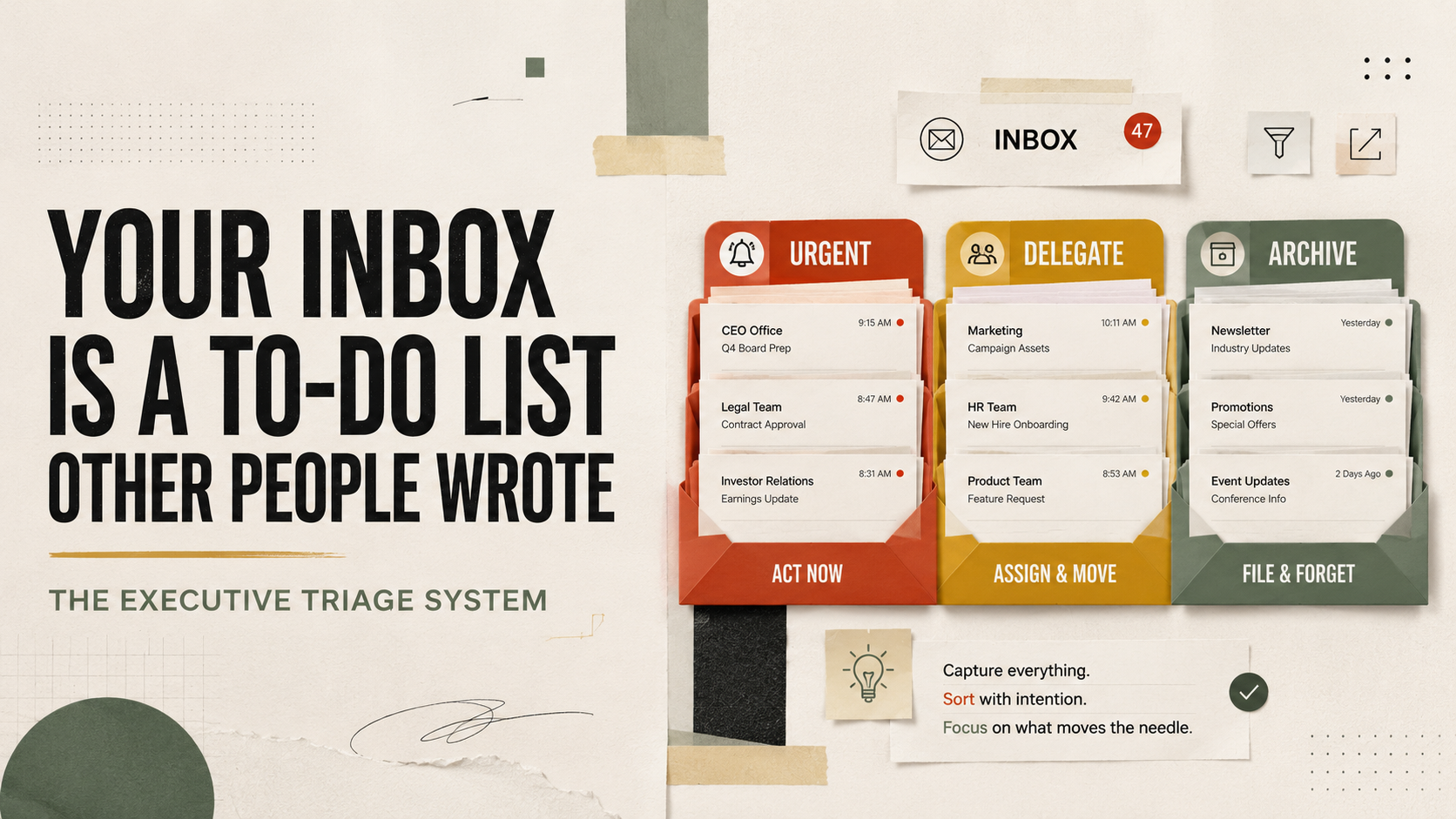
Most executives are losing two to three hours a day to email, and the productivity advice they get is worse than useless. "Reach inbox zero." "Check email only twice a day." "Use folders." None of it survives contact with a real leader's Monday, because none of it addresses what an inbox actually is.
Here's the reframe that changes how you treat it: your inbox is a to-do list that other people wrote for you. Every message is someone else's priority, arriving in the order it suited them, demanding a slice of your attention. Treating that list as if it reflects your priorities is the original sin of email, and it's why "getting through my inbox" feels productive and accomplishes so little. AI can finally fix this, but not by writing faster replies. By triaging the list before you ever touch it.
Speed was never the problem
The instinct with AI and email is to make replying faster. Auto-drafts, quick responses, suggested replies. That helps at the margin, but it's solving the wrong problem. The problem was never how long each reply takes. It's that you're processing eighty messages to find the six that matter, and the sorting is what drains you, not the typing.
An hour of email isn't an hour of writing. It's mostly an hour of low-grade decisions: is this important, can it wait, who should handle it, do I even need to respond. Made eighty times before lunch, those micro-decisions are what leave you depleted. AI's real leverage is taking that sorting off your plate so you arrive at your inbox already knowing where to look.
The triage system
The system is built on one idea from emergency medicine: not everything gets treated in arrival order, and not everything gets treated at all by the most senior person. Every incoming message sorts into one of three buckets before you engage with it.
- Respond now. Genuinely important and genuinely yours. The small number of messages that actually need your judgment today. For most executives this is a handful, not a flood, once it's separated from the noise.
- Delegate. Needs a response, but not from you. Someone on your team can handle it, often better and faster. The tragedy of executive email is how much of it is work you're doing that you should be routing.
- FYI only. You're on it for awareness, not action. It needs to be read, or skimmed, or ignored, never a reply. This is usually the largest bucket and the biggest source of false urgency.
Here's where AI earns its place. Each morning, it processes your overnight inbox against that framework and hands you a short digest: here are the six that need you, here are the ones to delegate and to whom, here's a two-line summary of the FYI pile. You open your day looking at a triaged list of your priorities instead of a raw list of everyone else's.
What that actually changes
A tech leadership team I worked with was spending three hours a day, per leader, on email, and drowning. We didn't change their email platform or force new software. We built the triage layer on top of what they already used. AI summarized the overnight flow, sorted it into the three buckets, and drafted the "delegate" handoffs for a one-click send.
Email time dropped from three hours to about ninety minutes. But the number that mattered wasn't the ninety minutes saved. It was that critical messages stopped getting buried, because the important six were surfaced instead of hidden inside eighty. The leaders stopped starting every day underwater. The friction came out, and nothing about their tools changed. That's the tell of a good AI workflow: it removes friction from the existing process instead of adding a new one to learn.
The two rules that make it stick
Delegate for real. The "delegate" bucket only works if you actually let go. If AI flags a message as delegable and you handle it anyway "just this once," every time, you've built a beautiful system and kept the problem. The point of triage is to route work off your desk, not to admire how well-sorted your overload is.
Protect the FYI bucket from becoming a trap. The FYI pile is where false urgency hides. Trust the summary. If AI tells you the thread is informational, resist the pull to read all forty replies. The whole value is not spending your judgment on things that don't need it.
The bigger point
Inbox zero was always the wrong goal. An empty inbox tells you that you processed everything, not that you spent your attention on what mattered. A leader can hit inbox zero and have spent the entire morning on other people's low-value priorities. Triage optimizes for the right thing: your important few get your judgment, the delegable gets routed, and the noise gets summarized and released.
Your inbox will always be a to-do list written by other people. You can't stop that. What you can change is whether you work that list in the order and priority they chose, or whether AI re-sorts it into your priorities before you ever open it.
So here's the question for tomorrow morning: when you open your inbox, are you looking at your priorities, or at everyone else's, arranged in the order that suited them? If it's the second one, you don't have an email problem. You have a triage problem, and it's the most fixable hour in your day.
The full email-triage setup, including the digest prompt, is in the AI Productivity Roadmap. It's free to download.
Chris McIntyre is a Certified Speaking Professional and MIT AI Strategy certified. He has trained over 300,000 professionals worldwide on AI productivity, leadership, and accountability. Clients include Google, NASA, Comcast, and the United Nations.