
When AI Is Wrong but Plausible: The Executive Validation Loop
Aug 31, 2026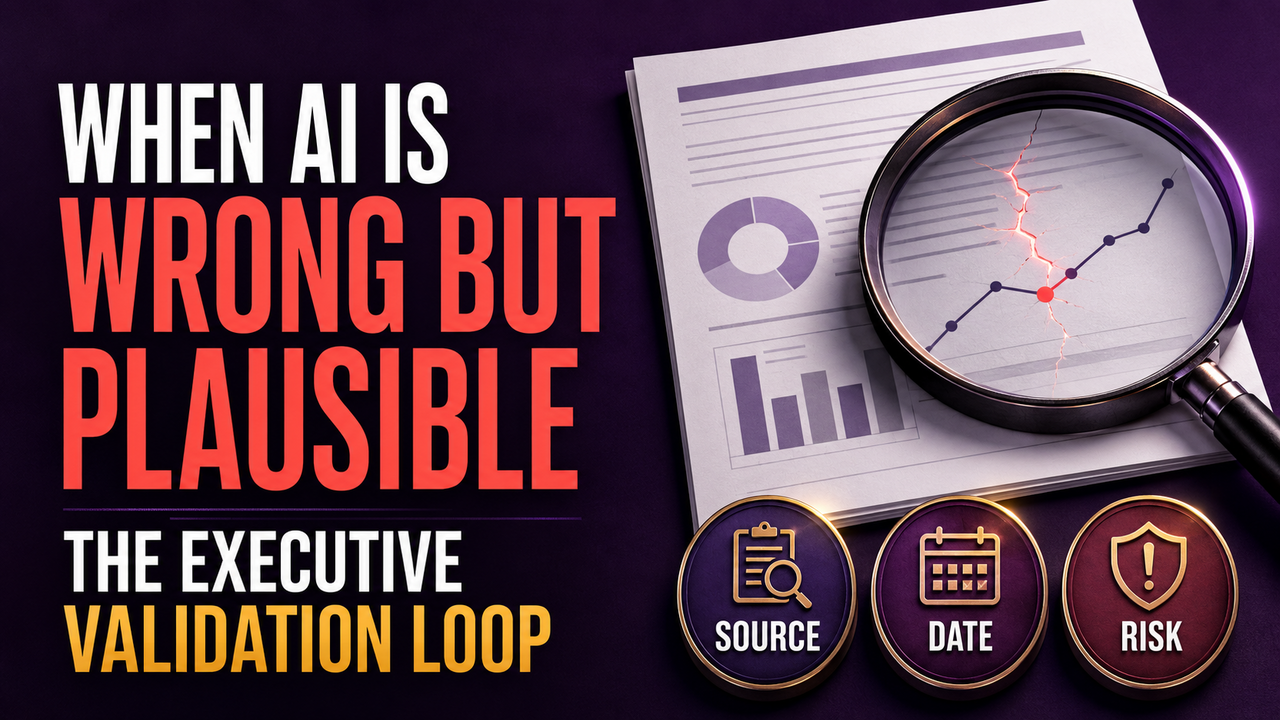
The AI error that will hurt you isn't the obvious one. It's not the hallucinated statistic that's clearly absurd, or the broken link, or the fact that reads wrong the moment you see it. Those get caught. You laugh, you fix it, you move on.
The dangerous one is the output that is confident, well-structured, professional, and wrong. The financial figure that's plausible but off. The legal interpretation that sounds authoritative and isn't. The market claim that fits your assumptions so neatly you don't think to check it. Modern AI is exceptionally good at being persuasive, and persuasiveness and accuracy are two different things that happen to look identical on the page.
For a senior leader, this is the real governance problem, and it doesn't get solved by picking a "safer" model or writing a longer policy. It gets solved by a habit: a validation loop you run on any AI output before it touches a real decision. Here's the one I teach, built from three questions, plus the one rule that sits above all of them.
Fluency is not accuracy
Understand why your instincts betray you here. For your whole career, fluency has been a decent proxy for competence. A polished memo usually came from someone who knew their stuff. Confident, well-organized writing signaled a confident, well-organized mind behind it. That heuristic served you well.
AI breaks it completely. It produces flawless fluency with zero underlying understanding. The polish that used to signal competence now signals nothing about accuracy at all. So the more professional an AI output looks, the more your old instincts tell you to trust it, at exactly the moment you should be checking it harder. The validation loop is how you override an instinct that's now actively working against you.
The three-question validation loop
Before any AI-generated input informs a decision that matters, run it through three questions. It takes about ninety seconds and it catches the plausible-but-wrong output that would otherwise sail straight through.
1. Source: where did this actually come from? Ask the AI to show its work and cite specifics. Not "it's generally known that," actual sources you can check. If it can't produce a verifiable source for a claim you're about to lean on, treat the claim as unverified, not as true. A confident assertion with no traceable source is exactly the failure mode you're guarding against.
2. Date: how current is this? AI is trained on information up to a point, and a great deal of what executives decide on is time-sensitive: regulations, prices, competitor moves, who holds what role. An answer that was right eighteen months ago and is delivered with total confidence today is a specific and common trap. Always ask what timeframe the answer reflects, and whether anything could have changed.
3. Risk: what happens if this is wrong? This is the one that sets your effort level. If the output is low-stakes and reversible, a light check is fine, move fast. If being wrong is expensive or hard to undo, the validation has to be proportionally heavier: a second source, a human expert, a deliberate look for disconfirming evidence. Match the scrutiny to the consequences. Not everything needs a full audit, but the one-way doors always do.
The human veto
Above the three questions sits one rule, and it's non-negotiable: a human holds the veto on any consequential decision, and that human is accountable for the outcome regardless of what the AI said.
"The AI recommended it" is not a defense, not to a board, not to a regulator, not to yourself. The moment you'd accept that as an excuse is the moment you've handed your judgment to a system that has none. The veto keeps a person in the loop who owns the call. It's not about distrusting the tool. It's about being clear that accountability doesn't transfer to software, ever. AI accelerates the work. It does not absorb the responsibility.
Build it into the workflow, not the willpower
The mistake is treating validation as a thing you'll remember to do. Under time pressure, with a beautiful output in front of you, you won't. It has to be built into the process instead.
Practically, that means the validation loop becomes a required step in any workflow where AI output feeds a real decision, the same way a second signature is required on a wire transfer. On my teams, high-stakes AI outputs carry a short tag before they move: source checked, date checked, risk level, and the name of the human who owns the call. It feels bureaucratic for about a week. Then it feels like the reason nothing blew up.
The reframe for leaders
This isn't about slowing down or being the AI skeptic in the room. It's the opposite. A validation loop is what lets you use AI aggressively and safely at the same time. When you trust the process that catches the plausible-but-wrong output, you can move fast on everything else, because you've got a net.
The leaders who get burned aren't the ones who used AI too much. They're the ones who trusted fluent output because it looked right, on a decision where being wrong was expensive, with no one accountable for the check. All three of those failures are preventable with ninety seconds and a habit.
So the question to carry into your next AI-assisted decision: if this output turned out to be confidently, plausibly wrong, who on your team would have caught it before it mattered, and what step in your process was supposed to make that happen? If you can't answer, you don't have a validation loop yet. You have trust in a system that earns fluency, not accuracy. Build the loop before you need it.
The full validation loop, including the workflow tag and the risk-tiering guide, is part of the AI Productivity Roadmap. It's free to download.
Chris McIntyre is a Certified Speaking Professional and MIT AI Strategy certified. He has trained over 300,000 professionals worldwide on AI productivity, leadership, and accountability. Clients include Google, NASA, Comcast, and the United Nations.