
How to Hire (and Brief) a Keynote Speaker on AI and Productivity
May 12, 2026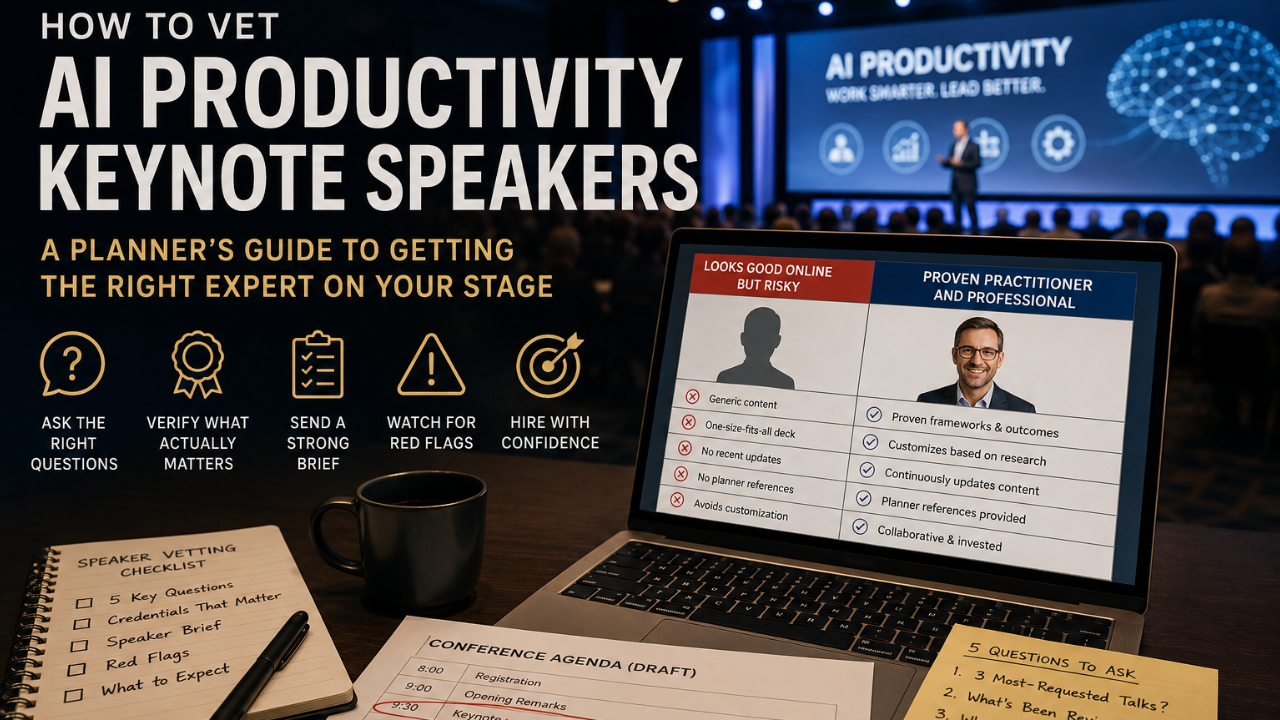
If you're sitting on a half-completed conference agenda and someone just dropped "AI productivity" into the keynote slot, you have a problem. Not a real problem. A vetting problem.
Every consultant, coach, and former tech executive on LinkedIn now claims AI productivity expertise. Most have read three Substack posts and built a PowerPoint. The actual practitioners — the ones who can land in a room of 800 senior leaders, deliver real frameworks, and have your audience emailing you on Monday saying "that was the best keynote of the conference" — are a much smaller group, and they don't always show up at the top of a Google search.
This post is the planner's-side companion to that vetting process. It's the questions to ask, the credentials that actually matter, the brief you should send before signing a contract, and the red flags I've seen burn other planners. I've been on the speaker side of this for 20 years and the planner side often enough to write both perspectives.
Five questions that separate real practitioners from impostors
Don't ask "do you speak on AI?" Everyone says yes. Ask these instead:
1. "Walk me through the three most-requested talks you delivered in the last six months." Real practitioners have a clear answer with specific titles, audience types, and what changed in each version. Impostors have a generic "I custom-build everything from scratch" answer that translates to "I don't have a tested deck."
2. "What's a frame or insight in your AI talk that you've revised in the last three months?" AI is moving so fast that any speaker whose deck hasn't changed in a quarter is using stale examples. The right answer is specific (something like, "I retired my GPT-3.5 demo and replaced the Copilot section because Microsoft shipped X").
3. "What do you take away from a customization call?" Listen for verbs: "I learn," "I ask about," "I dig into." If they're describing it as a list of slides they'll change, that's brand-applique. The good ones describe it as research.
4. "What's the audience walking away with that they can use Monday morning?" If the answer is "inspiration" or "a new way of thinking," they're a motivational speaker, not a productivity expert. If the answer includes specific tools, frameworks, prompts, checklists, or templates, you're talking to someone who actually does the work.
5. "Can you share two recent client references, and put me in touch with the planners who hired you, not the executive sponsor?" Sponsors will tell you the speaker was wonderful. Other planners will tell you whether the speaker was easy to work with, on time with materials, flexible on stage, and worth the fee. That's the call you actually need.
Credentials that actually matter (and ones that don't)
There's no licensing body for keynote speakers, which means anyone can call themselves anything. That said, three credentials are worth weighting:
Certified Speaking Professional (CSP), awarded by the National Speakers Association. Requires documented evidence of 250+ paid engagements over five years, plus client testimonials. Fewer than 12% of professional speakers worldwide hold it. It's not a guarantee of greatness, but it's a strong signal that the person can actually deliver, repeatedly, and bills like a business.
Subject-matter credential in their stated topic. For AI specifically, look for completion of a structured AI program (MIT Sloan AI Strategy, Stanford GSB AI for Leaders, Wharton AI for Business). Anyone can read AI books. Few have done the work to integrate the strategy thinking.
A book that's actually been bought, not just self-published. The difference shows up in reviews, citations, and whether the speaker can comfortably field questions outside their slide deck.
Things that don't matter as much as planners think: TEDx talks (anyone can get one), "#1 best-selling author" claims (often gamed via 4 a.m. Tuesday Amazon category placements), follower counts (uncorrelated with stage skill), and number-of-stages claimed (look for diversity of audience type, not raw volume).
The speaker brief: what to send before you sign
Most planners hire a speaker, then send a brief. The right move is the reverse: send a brief, then sign. A real practitioner will tell you upfront if your brief reveals a mismatch, and that's a gift.
A clean brief includes:
Audience composition: roles (C-suite vs. directors vs. front-line), industries, average tenure, gender/generational mix.
The 1-2 outcomes you most need from the keynote. "Audience leaves with a specific tool they can apply" is different from "audience feels energized."
What the audience just heard before this slot, and what they'll hear after. Flow matters more than planners realize.
Politically charged or sensitive topics to avoid. Every industry has them.
Format: keynote vs. fireside vs. workshop, length, AV setup, room layout.
Whether you'd like takeaway materials provided to attendees. Most senior speakers will say yes.
Send this in writing 4 to 8 weeks ahead. Then ask for a 30-minute discovery call. If your speaker doesn't take notes during that call, you've learned something.
Red flags I'd walk away from
After 2,000+ engagements as a speaker and dozens as a planner, the patterns that have always preceded a bad outcome:
"My standard talk is 60 minutes. We can adjust on the day if needed." Translation: I have one deck and I'll give it to you regardless of context.
Refusal to do a discovery call before contracting. "I have a great team that handles all that." The team handles logistics. You should be talking to the speaker about content.
Deck shared as "my standard PowerPoint, just so you can see." Pre-customization decks are a tell that customization isn't really happening.
Travel demands wildly out of proportion to the audience size. First-class flights for a 200-person regional conference, full per-diem for a half-day. The economics should match.
"I never do Q&A." Strong speakers welcome it. Weak ones avoid it because their content doesn't hold up to questions.
What to expect from the right speaker
When you've found the right person, whether it's me, one of my colleagues, or someone else entirely, the engagement should feel like this:
They reply to your inquiry within 48 hours, with a question rather than a quote. The discovery call is more interview-of-you than pitch-of-them. The customization is a real revision, not a name swap. The pre-event kit is detailed and proactive. Day-of, they arrive 90 minutes early, walk the stage, and ask about the cable runs. The talk lands. Your audience emails you on Monday. The speaker sends you a thank-you note (with photos) by the end of the week.
That's the shape of a well-run engagement. Anything materially different from that is worth a conversation.
If you're vetting AI productivity speakers right now
If your event is in the next 90 days and you're trying to fill an AI productivity slot, my Speaker Kit is free to download. It includes my 2026 talk titles, audience-by-audience customization examples, three reference letters from recent corporate engagements, and the technical AV requirements doc. You can decide if I'm the right fit in about 15 minutes.
Or if you'd rather just talk for 30 minutes about your event specifically, not about me, that's also free. The Contact page has the link.
Chris McIntyre is a Certified Speaking Professional with 20+ years and 2,000+ keynotes across all 50 U.S. states and four continents. He has spoken for Google, NASA, Comcast, Lucasfilm, the United Nations, NCAA, and YPO. MIT AI Strategy certified.