
Meeting Compression: How to Turn a 60-Minute Meeting Into a Six-Line Decision
Aug 03, 2026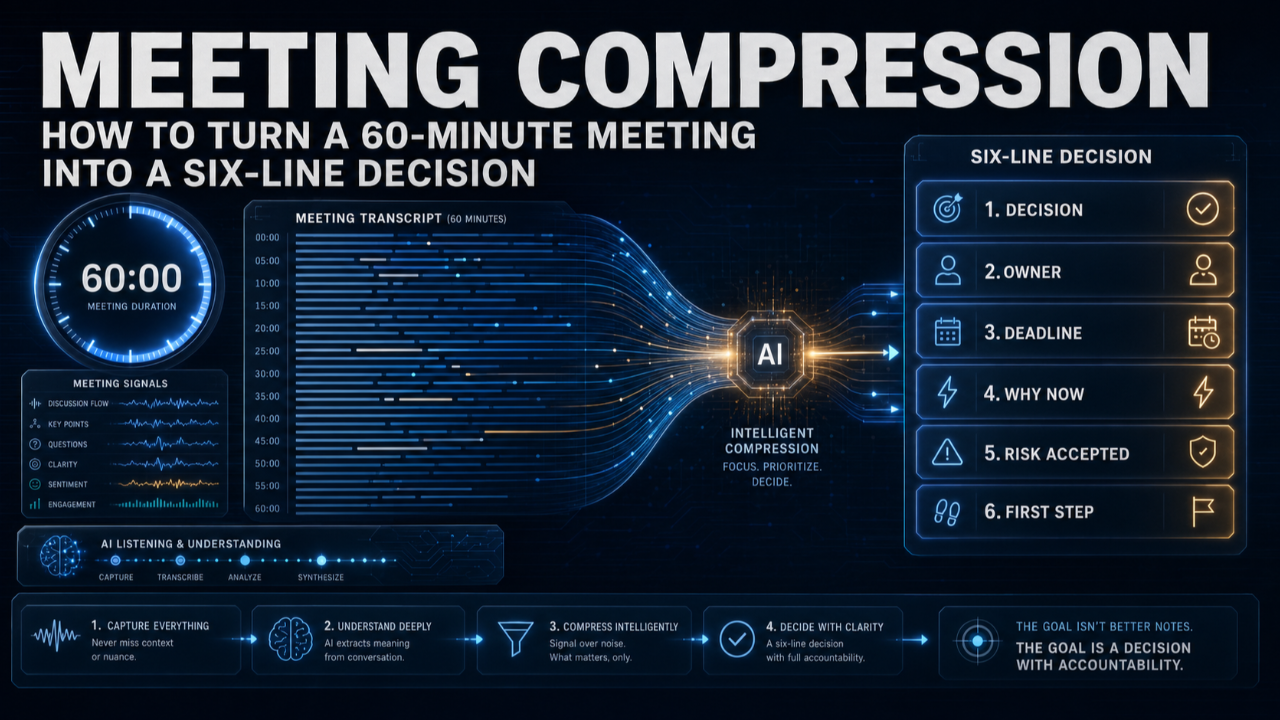
Sit in on almost any leadership meeting and watch what it produces. Sixty minutes of good discussion, a few heads nodding, a vague sense that something was agreed. Then everyone walks out and reconstructs a different version of what happened. Two weeks later, the same topic is back on the agenda because nothing was actually decided.
Now there's an AI notetaker in the room, so you also get a transcript. A 4,000-word transcript that no one will ever read. You've automated the record of the problem without touching the problem.
The problem was never a lack of notes. It's that a meeting is supposed to produce a decision, and most meetings produce a discussion. AI can fix that, but not the way it's usually sold. Here's the loop I install with leadership teams, and why a well-run 60-minute meeting should end in six lines, not six pages.
The output test
Before I touch anyone's calendar, I ask one question about each recurring meeting: what is this meeting supposed to produce? Not "what's it about," what does it output.
If the honest answer is "a shared understanding," that's often an email. If the answer is "a decision," then the meeting has failed unless a decision comes out of it, in writing, with a name and a date attached. Most meetings can't pass this test, which is exactly why they keep recurring. Nothing ever closed.
This is what "meeting compression" actually means. Not shorter meetings for their own sake. Meetings that reliably convert an hour of talk into a decision you can act on, so the topic never has to come back.
The six-line decision memo
The artifact I'm driving every meeting toward is deliberately tiny. Six lines. It's small on purpose, because the discipline is in the compression.
- Decision: the single sentence of what we're actually doing.
- Owner: one name. Not a team. A person.
- Deadline: a date, not "soon."
- Why now: the one-line rationale, so future-you remembers the logic.
- Risk we're accepting: the tradeoff we're knowingly taking.
- First step: the smallest next action and when it happens.
If you can't fill in those six lines, you didn't make a decision, and the meeting isn't over. That's the whole trick. The memo is a forcing function. It exposes the fake agreements while everyone is still in the room to fix them.
Where AI actually earns its place
Here's the loop. For the last five minutes of the meeting, someone feeds the running notes or transcript into a simple prompt and asks the AI to draft the six-line memo. Not summarize. Draft the decision in that exact structure.
The prompt is close to this: "You are a chief of staff. From these meeting notes, draft a decision memo in exactly six lines: Decision, Owner, Deadline, Why now, Risk we're accepting, First step. If any line cannot be filled from the notes, write MISSING and state what question we still need to answer."
That "write MISSING" instruction is the point. The AI will surface, in front of the whole group, that no owner was ever named or no deadline was ever set. You read the draft aloud, the room fills the gaps in ninety seconds, and you leave with a real decision instead of a warm feeling.
The AI isn't making the decision. It's refusing to let you pretend you made one. That's a very different, and much more valuable, job than taking notes.
The numbers, and the part that actually matters
A leadership team I worked with was running a standing two-hour weekly. We didn't shorten it by fiat. We put the output test and the six-line memo on it. Within a month the same meeting was running about seventy minutes, because half the agenda turned out to be discussion items that never needed a room, and the items that stayed actually closed.
Call it fifty minutes a week per person, across nine people. That's real time. But the number that mattered wasn't the minutes. It was that topics stopped boomeranging. The single biggest source of wasted executive time isn't long meetings, it's the same decision getting relitigated three times because it was never written down the first time. Compression kills the boomerang.
Two ways this goes wrong
Mistake one: you let the transcript become the deliverable. A transcript is raw material, not an output. If your "AI meeting solution" ends with a summary email nobody reads, you've added a step, not removed one. The deliverable is the decision, and it has to be short enough that people actually read it.
Mistake two: you compress the meeting but not the accountability. A decision with no named owner isn't compressed, it's just briefer. The owner and the deadline are the two lines people most want to leave blank, and they're the two that make the whole thing real. Guard them.
Start with one meeting
You don't roll this out across the org on Monday. You pick your worst recurring meeting, the one that keeps eating an hour and closing nothing, and you install the loop on that one meeting. Require the six-line memo. Let the group feel how different it is to leave with a decision instead of a discussion. Then let it spread on its own, because it will.
So here's the question to take into your next meeting: if you had to produce the six-line decision memo in the final five minutes, could you fill in the owner and the deadline right now? If you're not sure, that's not a note-taking problem. That's a decision that was never actually made, and it's costing you the meeting after this one.
The full meeting-compression loop, including the prompts and the memo template, is part of the AI Productivity Roadmap. It's free to download if you want to run it with your team.
Chris McIntyre is a Certified Speaking Professional and MIT AI Strategy certified. He has trained over 300,000 professionals worldwide on AI productivity, leadership, and accountability. Clients include Google, NASA, Comcast, and the United Nations.