
The One-Page AI Policy Your Company Actually Needs
Nov 09, 2026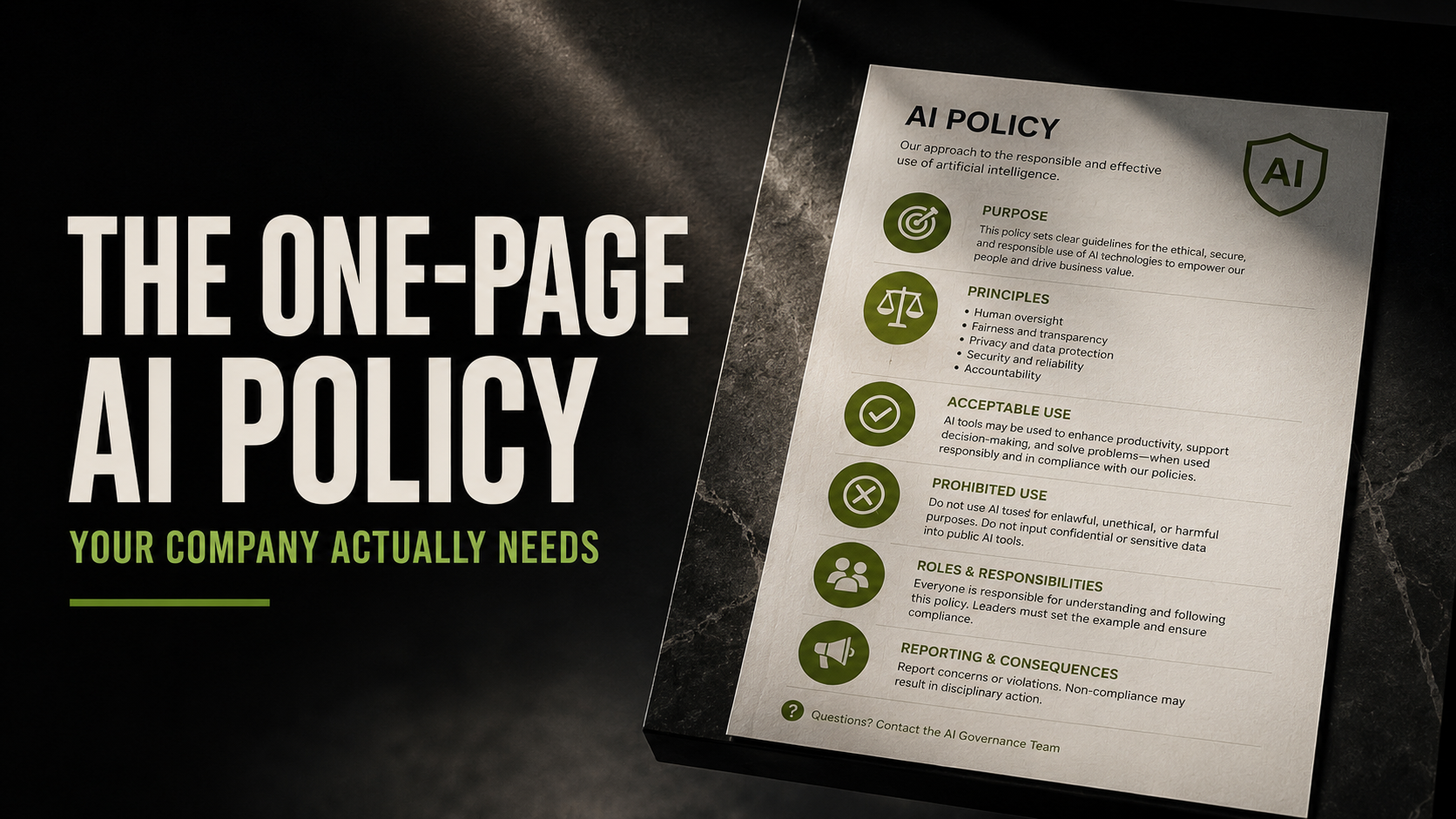
Most companies are handling AI governance in one of two ways, and both are failing. The first is to have no policy at all, which means every employee is quietly making up their own rules about what's safe to paste into a chatbot. The second is to commission a sprawling, lawyer-drafted document that runs twelve pages, covers every conceivable scenario, and gets read by exactly no one. A policy nobody reads governs nothing.
There's a better target, and it's more achievable than most leaders think. The AI policy your company actually needs fits on one page, gets read in three minutes, and answers the handful of questions that cause 95% of the real risk. Governance isn't about anticipating every edge case. It's about giving your people clear, memorable rules for the situations they'll actually hit on a Tuesday.
Why the twelve-page policy fails
The instinct behind the long policy is understandable: cover everything, so no one can say they weren't warned. But comprehensiveness and effectiveness are almost opposites here. The longer and more exhaustive the document, the less likely anyone internalizes it, and a rule that isn't internalized doesn't change behavior in the moment that matters.
The moment that matters is small and fast. It's an employee with a deadline, a chatbot open, and a document they're about to paste in. They are not going to stop and consult page nine of the AI policy. They're going to do whatever feels normal. Your policy's only job is to make the safe choice the obvious one in that three-second window. A page they remember beats a binder they don't.
What the one page has to answer
A useful AI policy answers four questions, in plain language, that every employee will actually face.
1. What can I put into AI tools, and what can't I? This is the single highest-risk question and the one people most need answered. Draw the line clearly: never paste customer data, credentials, unreleased financials, or anything covered by a confidentiality obligation into a public tool. Give concrete examples of both sides. Most real exposure comes from well-meaning people who simply never got a clear line.
2. Which tools are approved? Name them. "Use these specific tools for work" prevents the sprawl of people trying random apps of unknown provenance. If you leave it open, you've effectively approved everything, including the sketchy browser extension someone installed last week.
3. Do I have to disclose when I used AI, and to whom? Set the expectation. For most companies the honest rule is simple: AI can assist, but a human is accountable for anything that goes out, and certain high-stakes outputs (client deliverables, anything legal or financial) get human review before they ship. People want to know where the line is. Tell them.
4. Who do I ask when I'm not sure? Name a person or a channel. The most dangerous employee is the one who hits a gray area, can't find guidance, and just guesses. A clear "when in doubt, ask here" turns uncertainty into a question instead of a risk.
The principle that ties it together
Underneath the four questions sits one principle worth stating explicitly at the top of the page: AI can do the work, but a human owns the result.
That single sentence resolves most edge cases the twelve-page document tries to enumerate. Can I use AI to draft the client proposal? Yes, and you own what's in it, so you check it. Can I use it to analyze the data? Yes, and you're accountable for the conclusion, so you verify it. The principle scales to situations you never anticipated, which is exactly what a short policy needs, because you can't list every case but you can install the judgment that handles them.
Governance-light, not governance-free
To be clear, one page is not an argument for being casual about this. The risks are real: data leakage, confidentially breaches, plausible-but-wrong outputs shipping unchecked, regulatory exposure. The argument is that a short, memorable, actually-read policy manages those risks better than a long, ignored one. The measure of a governance document is not how thorough it is. It's how much it changes what people do when no one is watching.
There's also a speed dividend. Companies with no clear policy tend to freeze, because employees are afraid of doing the wrong thing, so they either avoid AI entirely or use it in the shadows where you can't see it. A clear one-pager does the opposite: it gives people confident permission to use AI well, inside safe lines. Good governance doesn't slow adoption down. It's what lets you speed it up without getting burned.
Start today. You don't need a committee and a quarter. You need one page that answers those four questions, states the one principle, names the tools and the person to ask, and gets sent to everyone with a short note from leadership. You can refine it as you learn. What you can't afford is the current state, where every employee is silently writing their own policy and you're finding out what it was only when something goes wrong.
So the question for your own company: if you asked ten of your employees right now what they're allowed to put into an AI tool, would you get ten consistent answers, or ten guesses? If it's guesses, you don't have a policy, you have exposure. And the fix fits on a page.
A one-page AI policy template is included in the AI Productivity Roadmap. It's free to download.
Chris McIntyre is a Certified Speaking Professional and MIT AI Strategy certified. He has trained over 300,000 professionals worldwide on AI productivity, leadership, and accountability. Clients include Google, NASA, Comcast, and the United Nations.