
Redesigning Handoffs: What to Automate, What Must Stay Human, and the Last 5%
Aug 24, 2026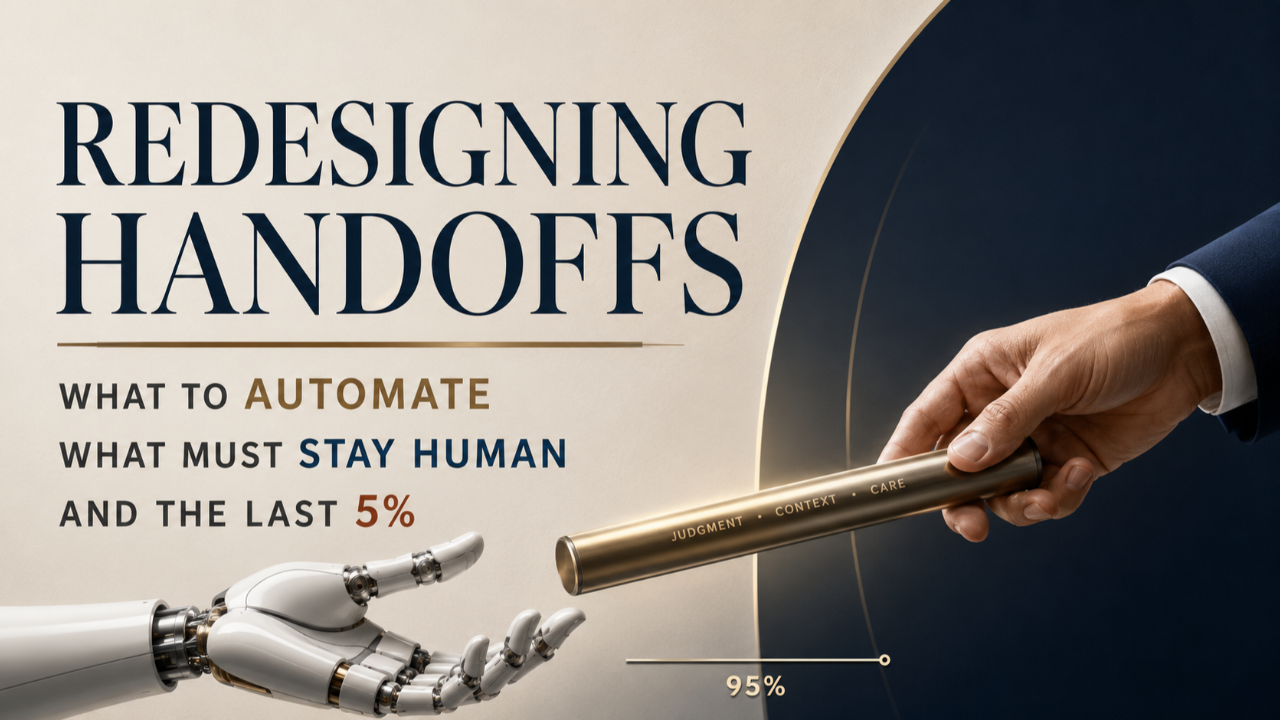
Most AI rollouts try to automate tasks. The leaders getting real cycle-time wins do something smarter. They redesign handoffs.
Here's the distinction, because it's the whole game. A task is one person doing one thing. A handoff is the moment work passes from one person, or one step, to the next, and it's where nearly all your organization's time actually leaks. The waiting. The reformatting. The "let me get back to you." The clarifying email that spawns three more. You can automate every individual task in a process and barely move the total time, because the time was never in the tasks. It was in the gaps between them.
So when I work on workflow compression with a leadership team, I don't start by asking "what can we automate?" I start by mapping the handoffs. That's where the compressible time lives, and it's also where the accountability questions get real.
Why handoffs are where the time hides
Pick any process that annoys you, onboarding a client, closing the books, approving a campaign. Now trace it not as a list of tasks but as a relay race. Watch the baton. Most of the elapsed time isn't anyone running. It's the baton sitting on the ground between runners: work waiting in someone's queue, sitting in an inbox, getting reformatted from the shape the last person left it in into the shape the next person needs.
That gap is the target. If a handoff currently means "Person A finishes, emails Person B, B reads it two days later, asks a clarifying question, waits for A," then AI's highest-value move isn't doing A's task or B's task faster. It's collapsing the handoff: packaging A's output into exactly what B needs, in the format B needs, with the likely questions already answered, so the baton never touches the ground.
The three-bucket test
Once you've mapped a process by its handoffs, every step sorts into one of three buckets. This is the test I use, and it's deliberately simple enough to run in a room.
Automate fully. The step is mechanical, rule-based, and reversible if wrong. Reformatting data, generating a first draft, pulling a standard report, routing a request. If a mistake here is cheap to catch and fix, hand it to AI completely and stop touching it.
Automate with a human check. The step benefits from AI speed but carries enough consequence that a person has to sign off. AI drafts the client email, a human sends it. AI proposes the budget reallocation, a human approves it. This is the largest bucket for most executive work, and the sign-off is not a formality, it's the control.
Keep human. The step requires judgment, relationship, or accountability that can't be delegated. Delivering hard news. Making the actual call on a one-way-door decision. Reading the room in a negotiation. Trying to automate these doesn't save time, it destroys the thing that made the step valuable.
The skill isn't knowing that these three buckets exist. It's being honest about which bucket each step is really in, instead of automating a "keep human" step because it was technically possible, or babysitting an "automate fully" step because you don't trust the tool yet.
The Last 5% Rule
Here's the principle that keeps compression from turning into a liability. On any step where AI does the heavy lifting, a human stays accountable for the last 5%.
AI can get a contract review, a financial model, or a customer response 95% of the way there in a fraction of the time. That 95% is real and worth having. But the last 5%, the judgment about whether this specific output is right for this specific situation, the catch on the subtle error, the ownership if it goes wrong, that stays with a named human. Not as a rubber stamp. As genuine accountability.
This is the line that separates leaders who compress safely from ones who get burned. The failure mode isn't AI doing 95% of the work. It's nobody owning the last 5%, so the 95% ships unchecked and the one time it's confidently wrong, it's wrong at scale with no one's name on it. Speed without an accountable owner isn't compression. It's just risk with a faster clock.
What it's worth
A services firm I worked with had a client-onboarding process that took eleven days. When we mapped it, only about a day and a half was actual work. The rest was handoffs: documents waiting to be reformatted, approvals sitting in queues, the same information re-entered by four different people.
We didn't automate the work. We collapsed the handoffs. AI packaged each step's output into exactly what the next step needed, pre-filled the repetitive fields, and flagged the two approvals that genuinely needed a human decision. Eleven days became four. The humans still owned every real judgment call, they just stopped spending a week passing paper. The last 5% of every consequential step still had a name on it.
Where to start
Don't try to compress everything. Take your single most frustrating cross-functional process, the one where you're always waiting on someone. Map it as handoffs, not tasks. Run each step through the three-bucket test. Then attack the biggest gap between runners, and put a name on the last 5% of anything you automate.
So here's the question worth asking about your worst process: how much of its total elapsed time is actual work, and how much is the baton sitting on the ground? Once you see that number, you'll stop trying to automate tasks and start compressing the gaps, which is where the time was hiding the whole time.
The handoff-mapping tool and the three-bucket test are both in the AI Productivity Roadmap, free to download.
Chris McIntyre is a Certified Speaking Professional and MIT AI Strategy certified. He has trained over 300,000 professionals worldwide on AI productivity, leadership, and accountability. Clients include Google, NASA, Comcast, and the United Nations.