
The Real Reason Remote Teams Lose Accountability (And How to Fix It in 30 Days)
May 25, 2026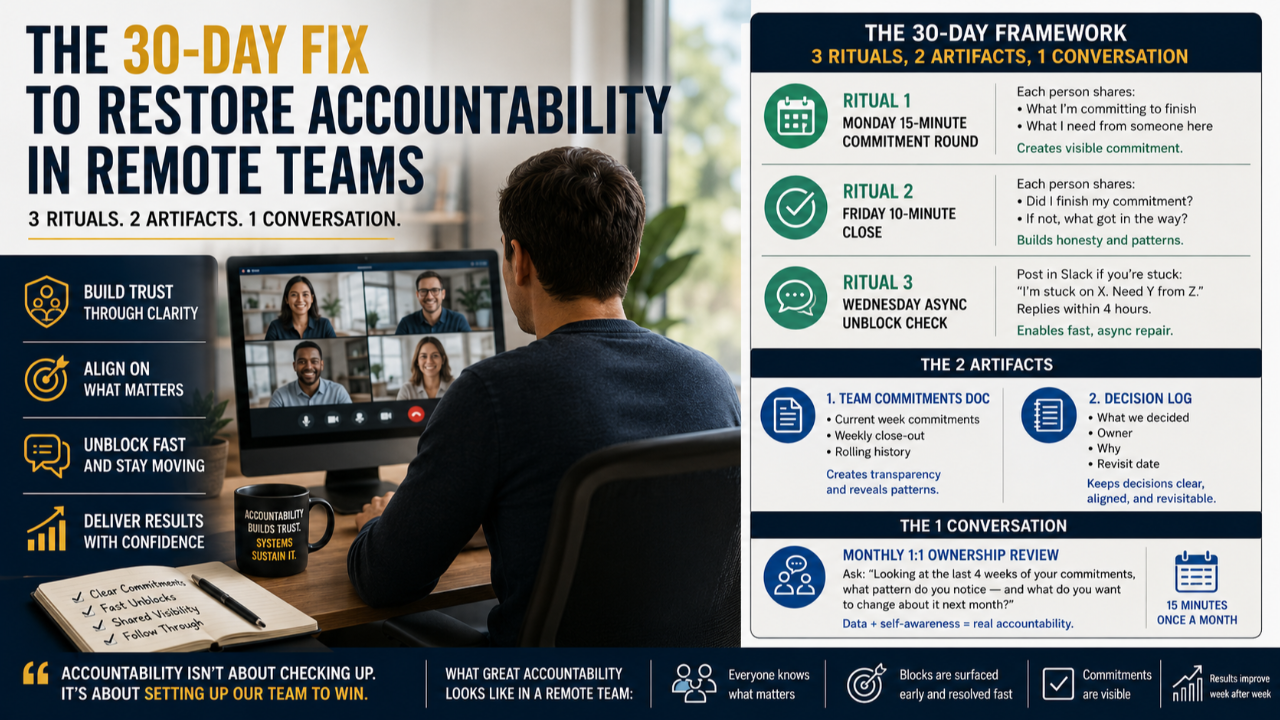
Three years into the great work-from-anywhere experiment, the same conversation keeps showing up in my coaching sessions and my workshops. A senior leader leans forward, lowers their voice, and says some version of: "My team isn't being held accountable the way they used to be. I don't know if it's the people or the setup or me."
It's almost never the people. It's almost always the setup.
Accountability — the everyday version, not the HR-doc version — was an emergent property of how offices worked. Walking by someone's desk, hearing what they were working on in the kitchen, sitting next to them in a meeting and seeing their body language when a deliverable came up. None of those signals exist in a Zoom-and-Slack environment. Most leaders responded by adding more meetings, more status updates, more dashboards. None of which are actually accountability. They're surveillance theater.
Real accountability in a remote team is a system. Below is the 30-day version I walk leadership teams through. It's three rituals, two artifacts, and one conversation. Most teams can implement it without buying any new software.
Why the office-era playbook stopped working
Before the fix, a quick honest diagnosis. The accountability your team had in the office was held together by three invisible scaffolds:
- Ambient awareness — you knew, without anyone saying so, that someone was stuck or behind, because you walked past their desk and saw them staring at their screen.
- Cheap synchronous repair — when something was off, you'd grab a coffee, talk for 8 minutes, and the issue would be resolved without anyone scheduling a meeting.
- Visible commitment — when someone said "I'll have it by Friday," everyone heard it and saw it. There was no plausible deniability.
Those three things did 80% of the accountability work. They evaporated when teams went distributed, and most leaders tried to replace them with calendar invites and project management tools — neither of which can actually do the same job. The fix isn't more tools. The fix is a deliberate set of rituals that recreate those three signals on purpose.
The 30-day fix: 3 rituals, 2 artifacts, 1 conversation
[BOLD] Ritual 1: The Monday 15-minute commitment round
Every Monday at the same time. 15 minutes max. Each person on the team — in a fixed order, no skipping — answers two questions: "What's the one thing I'm committing to finish this week?" and "What's the one thing I need from someone here to make that happen?"
That's it. No status, no updates, no calls for help that turn into 20-minute discussions. Anything that needs more time gets a separate calendar invite, but the commitment is already on the record. This single ritual recreates the "visible commitment" scaffold from office days. Done well, it adds 15 minutes to your week and removes 4 hours of "where are you on that?" Slack pings.
[BOLD] Ritual 2: The Friday 10-minute close
Every Friday at the same time. Same fixed order. Each person answers one question: "Did I finish what I committed to on Monday — yes, no, or partially? If not, what got in the way?"
Notice what's not in there. No defensiveness. No "who's to blame." No improvement plans. Just the structured public moment where each person tells the truth about what they did. After about three weeks, two things start to happen: people get better at scoping their Monday commitment to something they can actually finish, and the "what got in the way" answers start to show patterns that you, as a leader, can act on.
[BOLD] Ritual 3: The mid-week unblock check
Wednesday morning. Async. A single Slack thread that anyone can post to: "I'm stuck on X. Need Y from Z. Will be blocked until tomorrow if not resolved." Replies expected within 4 hours from the named person.
This is the "cheap synchronous repair" replacement. The point is to give people permission to surface a block without needing to schedule a meeting, and to set the expectation that blocks get resolved fast. Most weeks, the thread is empty, and that's fine. The thread existing is half the value, because it gives the team a low-friction way to say "I'm stuck" without it feeling like an escalation.
The two artifacts that hold it all together
Artifact 1: The Team Commitments doc
One Google Doc, OneNote page, or Notion page. Top of the doc is the current week's Monday commitments — one line per person. Below that is the rolling history of past weeks. Anyone on the team can see who committed to what and how the close-out went.
This sounds basic. It is. The point isn't sophistication. It's making commitments visible across the team without anyone having to ask. After 4-6 weeks of running this, you'll see patterns: which team members consistently over-commit, which under-promise, which keep getting blocked by the same upstream dependency.
Artifact 2: The Decision Log
Same doc, separate section. Every time the team makes a decision — even a small one — it goes here in this format: "On [date], we decided [what], owner [name], because [reasoning], revisit on [date]."
Most accountability problems on remote teams aren't "someone didn't do their work." They're "we forgot what we decided" or "two people had different versions of the decision." A simple shared decision log eliminates 80% of those failures and gives your team a defensible audit trail when stakes are high.
The one conversation: monthly 1:1 ownership review
Once a month, in your normal 1:1 with each direct report, spend 15 of the 30 minutes on one structured question: "Looking at the last 4 weeks of your Monday commitments, what pattern do you notice — and what do you want to change about it next month?"
This is where individual accountability becomes leadership accountability. You're not telling them what to fix. You're surfacing the data and letting them see it themselves. Most people, when shown a clean record of what they actually did vs. what they committed to do, course-correct without you saying a word. The few who don't, you'll know quickly, and that's the conversation you actually need to have.
What you should expect to see by day 30
If you implement these three rituals, two artifacts, and one conversation consistently for 30 days, three things should change measurably:
- Status meetings shrink or disappear. The Monday round and Friday close replace 80% of the "so where are we on that?" overhead. You'll get 2-4 hours back per person per week.
- Commitments get smaller and more reliable. People stop committing to vague things ("work on the launch") and start committing to specific things they can actually finish ("draft the launch announcement and send to John for review"). The hit-rate on weekly commitments rises from ~50% to ~85%.
- Difficult performance conversations get easier. When someone is consistently missing commitments, you have 8 weeks of public, structured data instead of a vibe. The conversation goes from "I'm worried about your work" to "here's the pattern; what do you think is going on?"
Don't expect the system to be loved on day 1. Expect mild resistance for the first two weeks ("more meetings?"), grudging acceptance by week 3, and active defense by week 6 if you try to remove it. That's the trajectory I see in nearly every team that runs this.
What about software?
You don't need any. The Monday round can be in any video tool. The artifacts can be a Google Doc. The Slack thread is Slack. If your team is bigger than 12 people, you'll want to split into pods of 5-7 for the Monday round; otherwise the cycle takes too long and people stop paying attention.
If you want the longer version of this — the part that covers escalation paths, what to do when someone is consistently missing, and how to handle the cross-team dependencies — it's in The Roadmap to Freedom. The book covers the framework end to end with worked examples from teams of 5 to teams of 500.
|
If you want help making this stick Get the book — The Roadmap to Freedom is the framework above plus 200 pages of how-tos for hiring, onboarding, decisions, and culture. Available at roadmaptofreedom.com from $9 (eBook) to $49 (full bundle). Or book a free 30-minute consultation — bring your specific team challenge and we'll work it through. Schedule at roadmaptofreedom.com/contact. |
Chris McIntyre is a Certified Speaking Professional, executive coach, and the author of The Roadmap to Freedom. He has worked with leadership teams at Google, NASA, Comcast, and 500+ other organizations across 20+ years.