
Stop Prompting Like It's Google: The Executive Briefing Habit That 10x's Your AI
Sep 21, 2026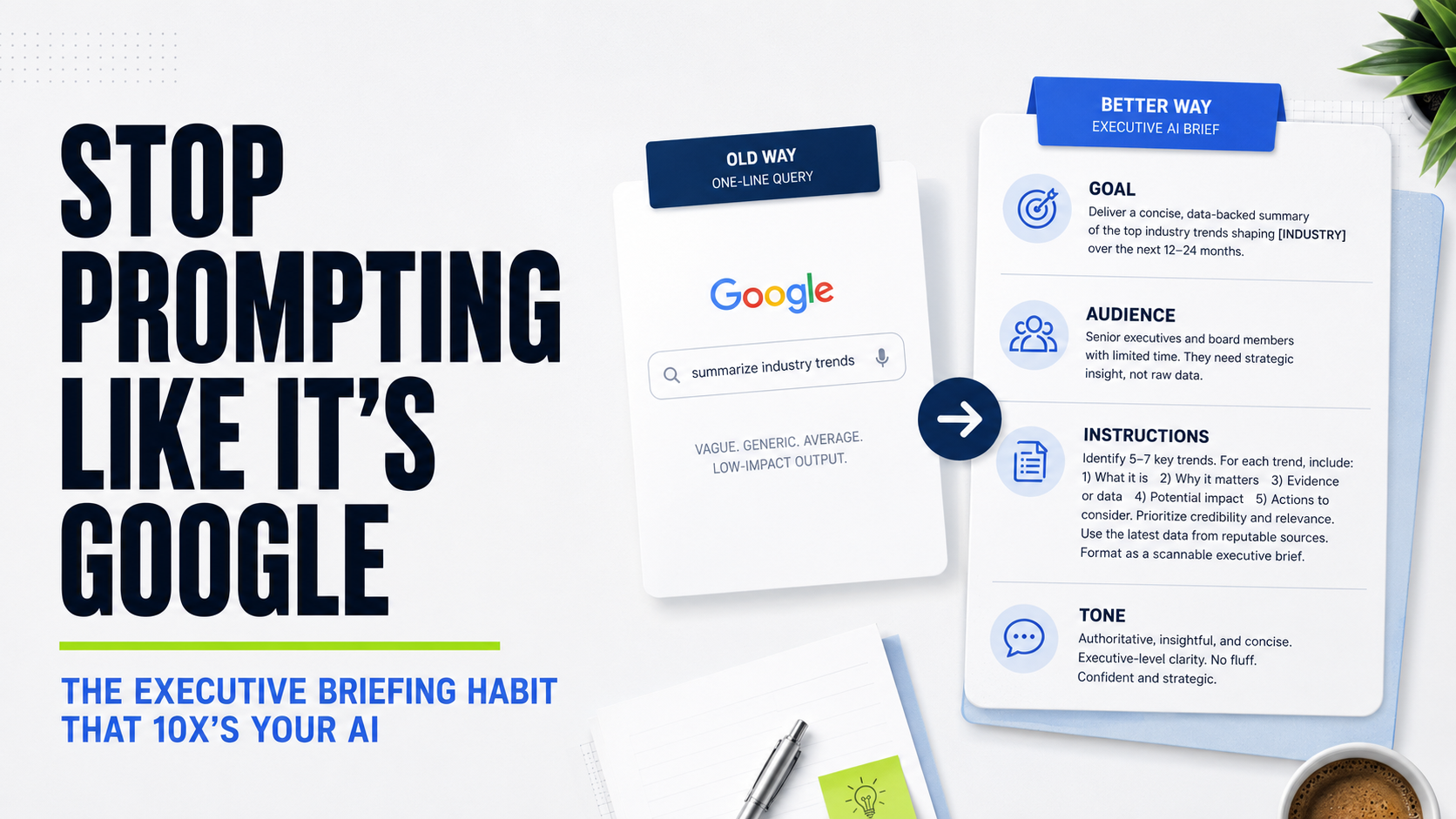
Watch a senior leader use AI for the first time and you'll almost always see the same thing. They type a short question, the way they'd type into a search bar. "Summarize trends in our industry." "Write a follow-up email." "What should I focus on this quarter?" They hit enter, get a bland, generic paragraph back, and conclude that AI is overhyped.
It's not the AI. It's the habit. They're prompting like it's Google, and Google trained all of us to be terrible at this. For twenty years, the winning move was to type the fewest words that would surface the right link. AI rewards the exact opposite, and until you break the Google habit, you'll keep getting Google-quality answers from a tool that's capable of far more.
Here's the one habit that separates the leaders who get real value from the ones who quietly give up.
You're not searching. You're briefing.
The mental model that changes everything is this: stop treating AI like a search engine and start treating it like a sharp new hire who happens to know a lot but knows nothing about your specific situation.
You would never walk up to a new chief of staff and say "write a follow-up email" and expect something useful. They'd have no idea who it's to, what it's about, what you're trying to achieve, or how you want to sound. You'd brief them. AI needs the same brief. The leaders getting 10x output aren't using secret prompts. They're just briefing properly, every time, out of habit.
The four-part brief
Every strong executive prompt has four parts. I teach this as G.A.I.T., and once it's a habit you stop thinking about it, the same way you stopped thinking about how to structure a delegation to a good assistant.
- Goal. The specific outcome you actually need. Not "help with the board update," but "a three-paragraph board update that lands the revenue miss without triggering panic."
- Audience. Who receives this. A message to your CFO and a message to your frontline team are different documents, and the AI can only know that if you tell it.
- Instructions. The constraints and context that matter. Length, what to include, what to avoid, the relevant facts about your situation. This is where the generic answer becomes yours.
- Tone. How it should sound. Direct. Warm. Formal. Skeptical. The same content in the wrong register is useless to a leader.
That's it. Goal, Audience, Instructions, Tone. Skip any one and the output degrades toward generic. Hit all four and the tool becomes the most patient, well-briefed junior partner you've ever worked with.
The same request, two ways
Take the world's most common executive prompt: "write a follow-up email."
The Google version gets you a template so bland you'll rewrite it from scratch, which means the AI saved you nothing.
The briefed version sounds like this: "You are my executive assistant. Draft a follow-up email to a prospective enterprise client I met yesterday (their VP of Ops, skeptical, short on time). Goal: get a 30-minute technical call booked next week. Include a one-line reference to the ROI concern she raised. Keep it under 120 words. Tone: warm but concise, no fluff, no exclamation points."
The second one gives you something you'd actually send, maybe with a small tweak. The difference isn't a clever trick. It's thirty extra seconds of briefing, and it's the entire gap between "AI isn't there yet" and "I can't imagine working without it."
Why leaders skip it, and why that's the mistake
The resistance to briefing is real, and it's worth naming. It feels slower. Typing four parts when you could type four words feels like overhead, especially for a busy executive who's used to moving fast.
But that math is backwards. The four-word prompt feels fast and then costs you ten minutes fixing a mediocre output, or worse, sending something generic. The thirty-second brief feels slow and then gives you something usable on the first try. You're not adding work. You're moving the thinking to the front, where it's cheap, instead of the back, where it's expensive.
There's a deeper point here too. Briefing AI well is the same muscle as delegating to people well, and most leaders are better at the second than they realize. You already know how to hand off work clearly. You just haven't transferred that skill to the tool yet, because the search box tricked you into thinking this was a different kind of interaction. It isn't.
Make it the default
The goal isn't to memorize a framework. It's to change a reflex. For the next week, before you hit enter on any AI request that matters, ask yourself whether you've given it the goal, the audience, the instructions, and the tone. It'll feel deliberate for a few days. Then it becomes automatic, the same way good delegation did.
And once it's automatic, the ceiling on what AI can do for you rises dramatically, because you've stopped capping it at Google-level answers.
So here's the question worth sitting with: think about the last time AI gave you a disappointing answer. Was the tool actually incapable, or did you hand it a four-word search when it needed a thirty-second brief? For most leaders, most of the time, it's the second one. And that's the best news possible, because it means the leverage was there all along. You just have to ask for it properly.
The full library of executive briefing templates is in the AI Productivity Roadmap. It's free to download.
Chris McIntyre is a Certified Speaking Professional and MIT AI Strategy certified. He has trained over 300,000 professionals worldwide on AI productivity, leadership, and accountability. Clients include Google, NASA, Comcast, and the United Nations.