
Why Your Best People Resist AI, and the Reframe That Wins Them Over
Oct 05, 2026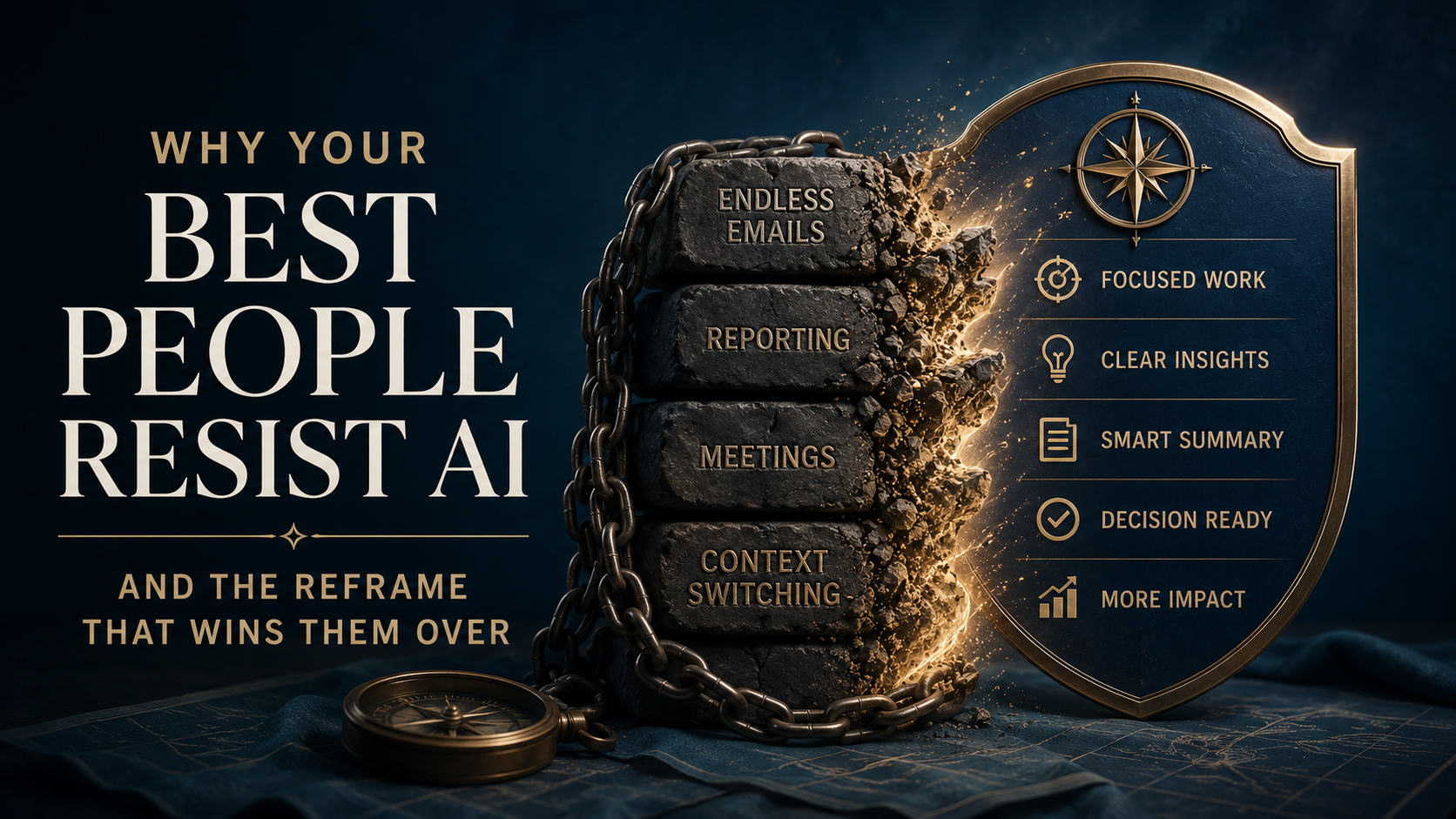
When AI adoption stalls inside a company, leadership almost always misreads why. The assumption is that the resisters are the laggards, the less capable, the people who can't keep up. So the response is more training, more pressure, more urgency.
Then you look closely at who's actually resisting, and it's often your best people. Your most experienced, most trusted, highest-performing leaders are the ones quietly not using the tools. And that should stop you cold, because it means the standard explanation is wrong. Your best people aren't resisting AI because they can't understand it. They're resisting for reasons that are, from where they sit, completely rational. Until you understand those reasons, no amount of pushing will work.
Why the strongest performers resist
Three reasons, and none of them is incompetence.
They have the most to lose. Your best people are excellent at their current way of working. They've spent years building a process that produces great results. Asking them to change it isn't asking them to learn a tool, it's asking them to trade a proven, high-performing method for an uncertain one. A rational expert protects what works. The novice has nothing to protect, which is why juniors often adopt faster and leaders read that as juniors being "better at AI." They're not. They just have less to risk.
Their value is tied to their expertise. A senior person's identity and status come from being the one who knows. A tool that seems to democratize their hard-won expertise can feel, at a gut level, like a threat to what makes them valuable. Nobody says this out loud. But "I don't really need it" is often "I'm not sure who I am if the thing I'm known for gets easier for everyone."
They've been burned by hype before. Your veterans have lived through a dozen "this changes everything" technology waves, most of which changed very little and cost a lot of time. Their skepticism isn't ignorance. It's pattern recognition. They're waiting to see if this one is real before they reorganize their working life around it, which is exactly what you'd want from a seasoned leader in every other context.
The reframe that turns them around
You don't overcome rational resistance with enthusiasm. You overcome it by changing the frame so that adopting AI becomes consistent with what your best people already care about, rather than a threat to it.
The reframe is this: AI doesn't replace your expertise. It removes the tax on it.
Your senior people spend a huge fraction of their time on work that's beneath their expertise, formatting, drafting, summarizing, chasing information, the connective tissue around their actual judgment. That's the tax. It's the price they pay to get to the 20% of their work that only they can do. AI doesn't touch the 20%. It collapses the tax, so they get more of their time back for the expert judgment that made them valuable in the first place.
Framed that way, AI stops being a threat to the expert and becomes the thing that finally lets them spend their time like an expert. That's a message a skeptical veteran can accept, because it's true, and because it honors rather than diminishes what they bring.
How to make the reframe land
Saying it isn't enough. Three moves make it real.
Let them see it on their own work. Don't send them to generic training. Sit with your best person on a task they personally find tedious, the report they hate building, the emails that eat their Friday, and let AI take the tax off that specific thing. Expertise-honoring adoption starts from their real pain, not a demo.
Put them in the judgment seat, explicitly. Make clear that their job is not to compete with the AI on production, it's to judge and direct it, which is the higher-status role. A veteran will happily supervise a fast junior. Frame the AI as exactly that, and their expertise becomes the point rather than the casualty.
Give the skepticism a job. Your veterans' pattern recognition for hype is an asset, not an obstacle. Ask them to help define where AI should and shouldn't be trusted in your workflows. When you make the skeptic the guardian of quality, resistance turns into ownership.
The mistake to avoid
Whatever you do, don't shame the resisters or make adoption a loyalty test. The moment "are you using AI yet?" becomes a compliance question, your best people will perform usage to satisfy you and change nothing real, which is worse than open resistance because now you can't see it. Rational people respond to a better frame, not to pressure. Give them the frame, let them test it on their own terms, and let the results do the persuading.
The deeper truth is that your best people's resistance is actually a gift, if you read it right. They're telling you exactly what a good rollout has to respect: proven methods, hard-won expertise, and earned skepticism. Build the reframe around those, and the same people who resisted longest often become your most credible advocates, because when a respected veteran changes their mind, everyone watches.
So the question to ask before your next push: are your best people resisting AI because they don't get it, or because you've been asking them to trade their expertise instead of amplify it? Change that one frame, and the hardest adopters in your company become the ones who bring everyone else along.
The full change-leadership playbook for AI adoption is in the AI Productivity Roadmap. It's free to download.
Chris McIntyre is a Certified Speaking Professional and MIT AI Strategy certified. He has trained over 300,000 professionals worldwide on AI productivity, leadership, and accountability. Clients include Google, NASA, Comcast, and the United Nations.